Category Archives: TFC

From Rehearsal to Hallelujah: Premiering Love Canticles

Every once in a while, I get to take part in a performance that adds something new to the world. Not just a new interpretation of a classic work, but an actual premiere—something no one’s heard before. Past highlights have included James MacMillan’s moving St. John Passion and Elena Langer’s delightfully strange The Dong With a Luminous Nose. This week, the Tanglewood Festival Chorus gets to introduce another such debut: the world premiere of Love Canticles, composed by Aleksandra Vrebalov and commissioned by the Boston Symphony Orchestra.

For the composer’s biography, background, and official program notes, the BSO has done its homework right here. You’ll read about her Yugoslavian roots, her longstanding collaboration with the Kronos Quartet, and her deep ties to Tanglewood. Love Canticles draws inspiration from Psalms 103 and 104, hymns of praise that focus on divine mercy, human mortality, and the spirit of creation. Designed as a companion to Stravinsky’s Symphony of Psalms—which shares the orchestration and the Biblical inspiration—it’s a thoughtful pairing that gives the pre-intermission program a thematic arc.

But my blogs aren’t history or theory lectures. They’re about the experience itself, namely: what’s it like to learn and rehearse a world premiere like this?

Modern Composers and Their Toys

One thing I’ve learned from these modern premieres is that contemporary composers love their toys. Not just odd harmonies or quirky rhythms, but full-on “wait, what did I just hear?” moments.

MacMillan’s piece gave us gimmicks like winding-down slides, haunting melismas, and murmured text. Langer leaned into tremolos, tone clusters, and cheeky motifs. Vrebalov, in turn, gives us three main tricks—each one adding a distinct texture without feeling too gimmicky or overindulgent.

First, her use of the glissando. At several points, Vrebalov emphasizes an interval or transition by asking the chorus to glide between notes. Unlike a portamento (a more gradual, often expressive slide), these glissandi start immediately, even between two adjacent pitches. This controlled Doppler effect sends a subtle chill down the spine, especially when the resonance lines up just right.
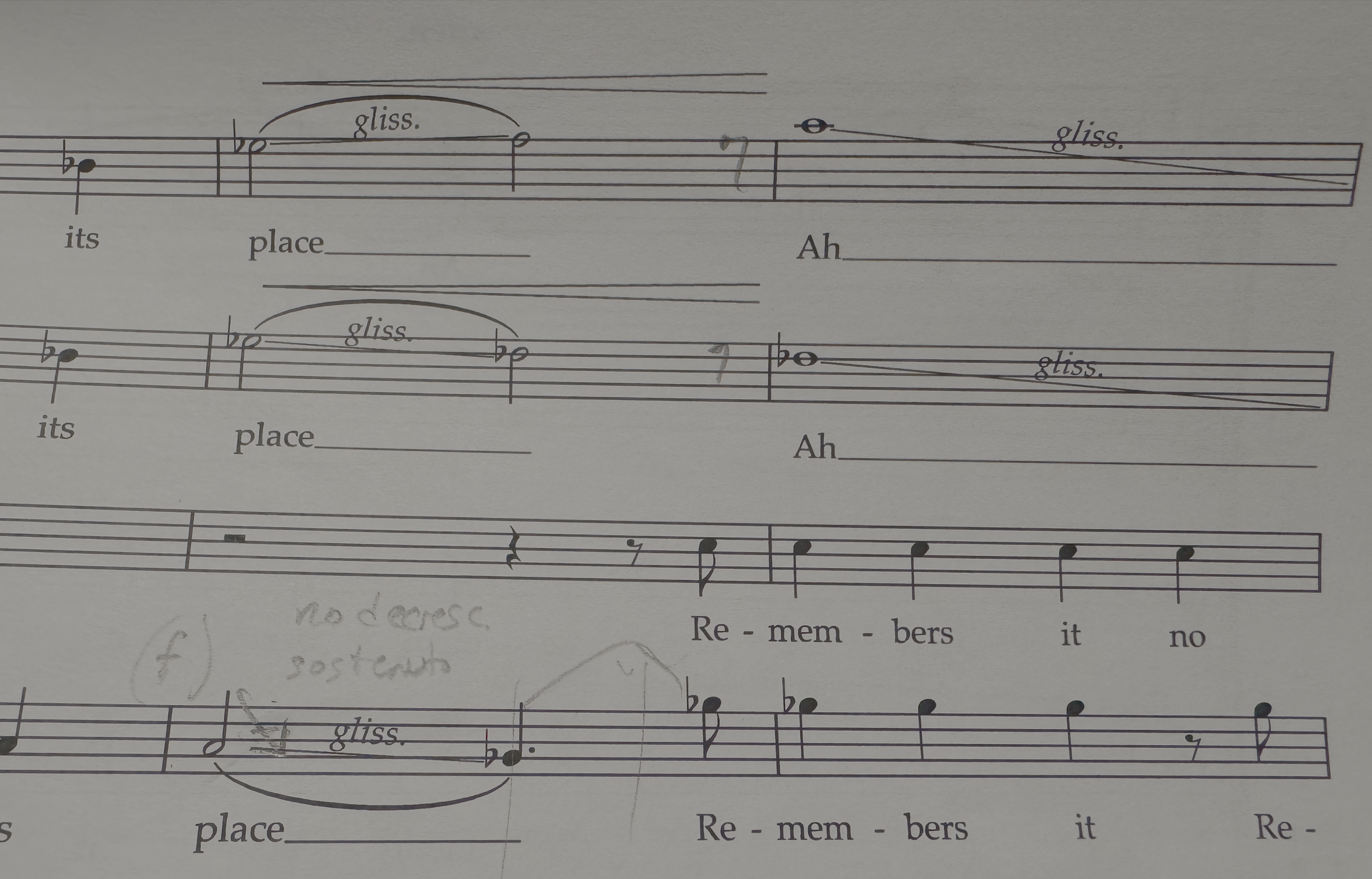
Second, the choral soloist moments. It may be a single baritone or tenor that hangs onto a note “as long as comfortable” after everyone else cuts off. It may be a soprano floating an isolated note across bar lines. Twice Vrebalov calls for a “solo soprano invocation, sprechstimme.” For those unfamiliar: sprechstimme is the half-spoken, half-sung style popularized by early 20th century expressionist composers like Schoenberg. (Though maybe popularized is the wrong word — let’s just say if sprechstimme had a fan club, it’d probably meet in a very small practice room.)

Finally, the quirkiest delight: morse-code chattering. We’re instructed to sing two alternating notes “random, like morse code,” or later “random, not too fast, breathe ad lib, within the beat.” The result? A soft, percussive texture—part chittering insect, part tonal snowstorm—nestled beneath melodic lines and an ethereal orchestral shimmer. It shouldn’t work. And yet, it absolutely does.

Technical Challenges, Emotional Payoff

Despite the avant-garde gestures, the piece has been surprisingly accessible to learn. (Perhaps more so for us basses, who merely hum a low note for the first 30 bars. Sorry not sorry.) The rhythmic shifts and subtle tempo changes keep us alert, but the score is clean and communicative. Now if I could just figure out how to count some of these triplets…

Unlike re-learning the Mozart Requiem—where you can choose from hundreds of different recordings, all with idiosyncracies that don’t match your current conductor’s choices—Love Canticles has no recordings, having just been finished a few months ago. We’re the first voices to give shape to these markings, dynamics, and gestures. It’s up to us to breathe life into the dots on the page.

James Burton, our conductor, has been carving space to talk about the music’s character (when he’s not reminding us to please observe the clearly marked accents, dynamics, and rhythms). “You’re psalmists,” he said recently. “Find joy in this. Or else, why are you here?”

Not every passage is joyful, though. The text and the music wander through questions of impermanence, vulnerability, even anger and defiance. And then, emerging in the final measures, Vrebalov gives us an extended Hallelujah—optimistic, weightless, and glowing. It’s an unbarred cadenza of calm, an unadorned F-major from nowhere that provides a sempre pianissimo moment of grace after all the histrionics and questioning. It’s not an answer, but it is a release.

Dead Men Tell No Tales

One benefit of performing living composers? They can show up and tell you what they actually meant by what they wrote, say over lunch. Dead white European men can’t tell you what they want. But in our final rehearsals this week, we’re expecting notes from Aleksandra Vrebalov herself. It’s a rare gift to be able to ask, “Was this the sound you imagined?” and get an answer.

How exhilarating it must be for her to write for a chorus and orchestra she’s long admired, then to hear her own music rise up, live, for the very first time. And how lucky for us, to be the ones bringing it into the world. We’re looking forward to singing these psalms of praise for her and our audience this weekend.

Old Friend, New Face: Singing the Mozart Requiem (Again)

The Tanglewood Festival Chorus is once again taking on the Mozart Requiem—another in the pantheon of choral works that audiences adore and turn up on concert programs like clockwork.

I’ve written before about singing the Requiem under the baton of Michael Tilson Thomas in 2010, and again with Andris Nelsons in 2017 with James Bagwell doing the honors in chorus prep. (Even interviewed him for a podcast.) Somewhere along the way I swore I’d never turn down a chance to sing the Mozart Requiem.

And here we are again. But as with those last two performance cycles, there’s always something to discover. No matter how many times you sing a piece, a good conductor (or two) will reveal entirely new dimensions to put a new face on an old friend.

A New Layer from James Burton

The TFC”s choral conductor, James Burton, had a lot more to work with than given almost all choral members knew the notes from the very first rehearsal. That meant he could focus on technique and musicality instead of simply rhythm and dynamics. So it was up to him to take this well-worn repertoire and coax new life from it—not by reinventing the wheel, but by refining it. His emphasis on vowel production might sound like standard choral fare, but his approach quickly got granular in ways that matter. Sometimes that took the form of obvious reminders, such as his guidance on cleaner vowel transitions with no sudden “yuh” or “wuh” between vowels. But it was also about getting a better response back from Symphony Hall itself.

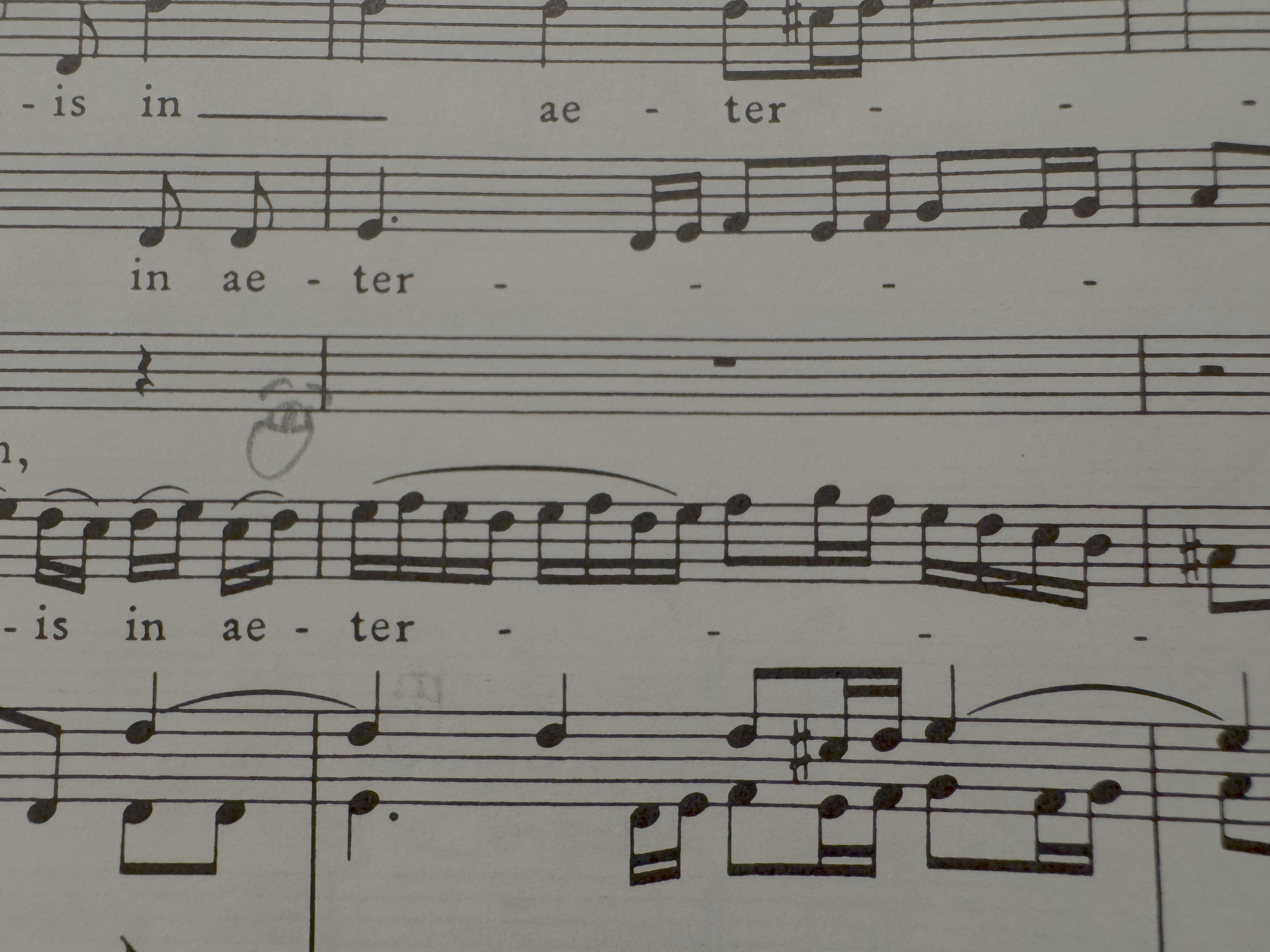
A circle and two squares reminds me to show my teeth on long runs of “aeterna”

Really, most of his vowel coaching was about shaping our mouths to resonate in a way that keeps the sound spinning. I even developed a new marking in my score—two tiny squares in a circle—to remind me to “show my top teeth” for the ideal /e/ vowel. Want to sing /o/? Make it sound more like “ah” and bring it forward. Want an /u/ with presence? Start with the space of an “ah,” then curve your lips around it without losing that raised soft palette. You could really hear the difference in an empty Symphony Hall during rehearsals when we adopted these techniques. “The Hall likes that,” James pointed out as the resonance filled the space. It also gave us more control over dynamics and more efficient breath.

His other big focus was phrasing, in two ways–the first being shaping them. More than once he urged us not to wait to be musical. “You’ve got four of the same note,” he challenged us. “What are you going to do with that?” He also reminded us that the style of the time was to “drop the dot” by turning dotted quarter notes into quarter notes and using the extra space to rearticulate the following phrase.

Three groups of two beats stops the basses from pounding the “ri” in “moriam” and properly emphasizing the “fa” of “facimus.”

The other coaching was in the relationships of phrases to measures and their downbeats. For instance, acknowledging hemiolas in the Hostias movement made a noticeable difference compared to charging through them as I had in the past.

Instead of emphasizing the first of each four-note grouping, this phrasing gave musical meaning to the sequence.

Another example is in the opening and closing fugues. THey have a particular figure that basses normally thump through in rigid 4-note groupings, but James urged us to change it to larger phrases that made a lot more sense developmentally.

The end result was a well-prepared chorus armed with musicality and responsive enough to react to the adjustments that would come from our guest conductor, Dima Slobodeniouk.

Enter Dima: Refining the Shape

Once James handed us off to Maestro Dima, the details only deepened.

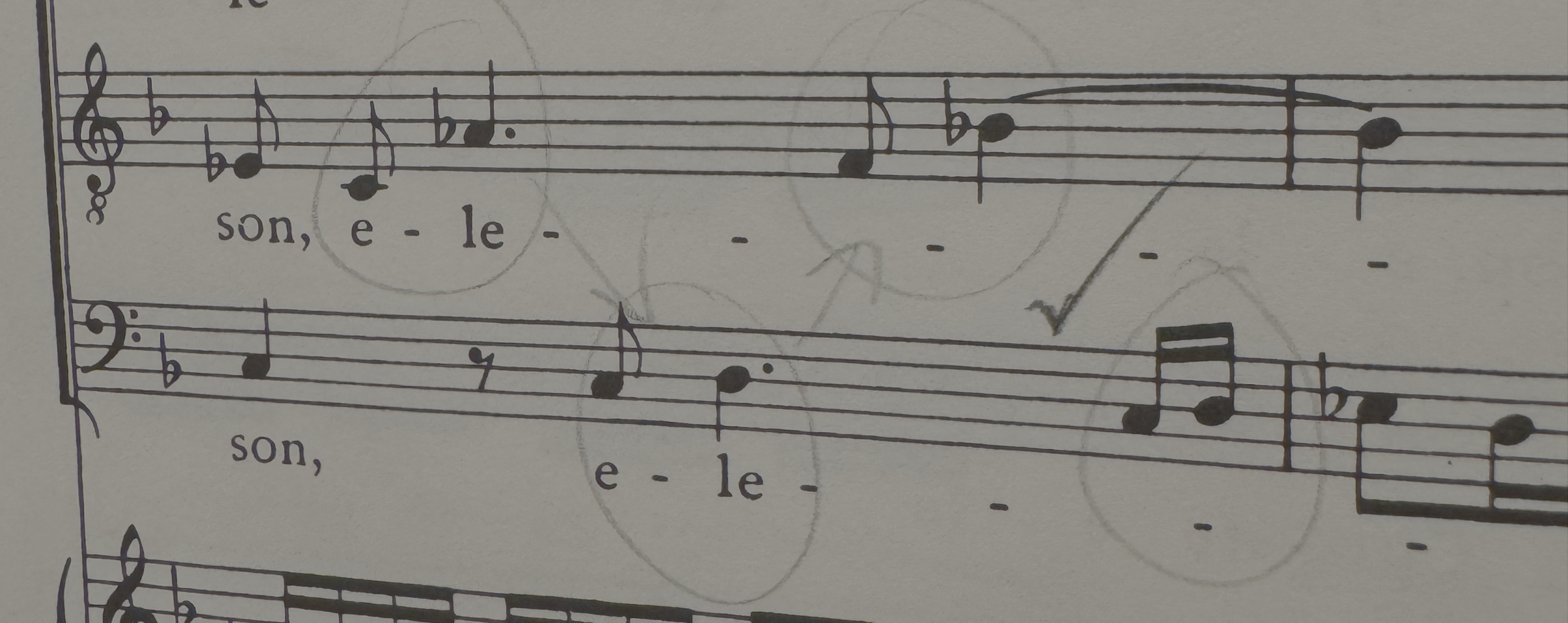
Dima’s approach brought a mix of precision and lightness, a chamber-music sensibility even within the scope of Mozart’s larger-than-life drama. (At times for us basses, it felt like he was trying to get elephants to do ballet. But let the record show, we tried.) Practically speaking, that often meant crisp articulation—like singing Rex shorter and sharper, letting the “ks” bounce through the hall. Or asking for more marcato when singing lux aeterna, so it cut cleanly through the orchestral texture. His favorite coaching words were “transparency” and “organically,” to give a more ethereal, more natural story-telling nature to the piece rather than the ponderous plodding you’d get from a pick-up choir at a summer sing.

An interpretation I hadn’t encountered – the third quantus tremor at piano then a subito forte.

Dima also took steps to treat Symphony Hall itself as an instrument. He’s adjusted dynamics and articulation not just for musical effect but to optimize how sound travels in that space. The Dies Irae, for example, isn’t always a full-on wall of fortissimo–the second time through we back off and leaned into a swell of phrasing. In one moment, we shaped quantus tremor as a gradual decrescendo—mf to mp to p—then hit a subito forte, the timpani sforzando removed to preserve the surprise.

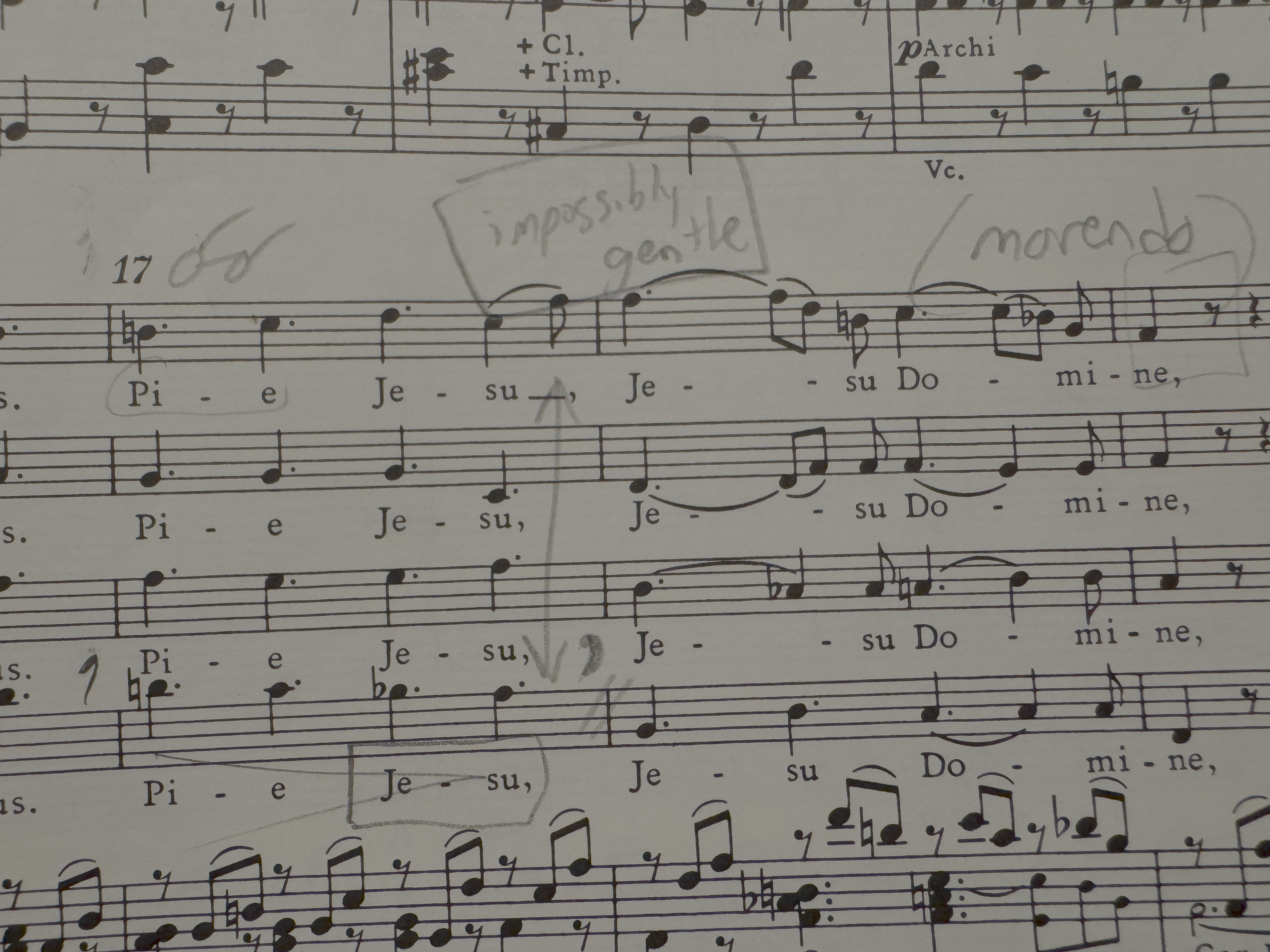
In prep time, James pointed out to us that when we sing Pie Jesu midway through the piece, it’s the first time we say Jesus’s name. “Don’t you think that should be a special moment?” So we were already treating it differently before we made it to the piano and orchestra rehearsals. Well, Dima apparently agreed, because he exhorted us to make that first Jesu “impossibly gentle,” with a space after it akin to railroad tracks before finishing the thought.

Dima was also focused on bringing out the interplay between voices, asking us to bring out the bouncing back and forth of imitative stretto entrances across the voices. In many cases that included interplay with the orchestra, asking us to key off of their entrances or asking them to pull back and be supportive of ours.

Perhaps most impressively, when working with the Boston Symphony Orchestra… well, let’s just say Dima wasn’t shy asking to get exactly what he wanted. He worked explicitly with some sections to get the tempi, pulse, and intonation he wanted from them.

The Familiar, Made Fresh

So here we are: another go-round with Mozart’s (and Süssmayr’s) final masterpiece. And yet, thanks to James, Dima, and a roomful of singers who still care, it still feels compelling and rewarding to be a part of it.

Maybe that’s why I keep saying yes to this piece. Not because it’s easy. Not because it’s new. But because with the right polish, even a battle axe can gleam.

The Song with a Luminous Future

This week at Symphony Hall, the Tanglewood Festival Chorus is tackling an unusual piece. It’s the American premiere of a contemporary work co-commissioned by the Boston Symphony Orchestra and the London Philharmonic Orchestra, first performed in London in March 2023. The piece is titled The Dong with a Luminous Nose, based on the Edward Lear poem of the same name. So for you concertgoers and interested choral bystanders, here’s a peek behind the scenes as we wrap up our study of the piece and head into the final rehearsals.

Why are we singing about a Dong? (And stop laughing.)

Edward Lear is known for his nonsensical poems, limericks, and drawings — call him a more melancholy Lewis Carroll, or perhaps a Dr. Seuss for adults of the late 1800s. More of us may be familiar with his The Owl and the Pussycat… which, once read aloud, may induce similar giggles from the puerile pre-teen in all of us. His works invent nonsense characters like the Bò, the Pobble, the octopod Discobboloses, the Quangle Wangle… and the Dong. In fact, we learned The Dong with a Luminous Nose is a sequel to Lear’s poem The Jumblies, which first describes the titular travelers who then join the Dong on the great Gromboolian plain before abandoning him.

In her program notes, composer Elena Langer describes how Lear’s poem has everything music wants. You’d like a love story? Songs and dances? Fantastical landscapes? The narrative has them all, along with an emotional backdrop of longing and hope, of light and sadness. In singsong verse, the poem tells how the Dong falls in love with a green-haired, blue-handed Jumbly Girl, only to have her vanish over the sea. Her departure drives the Dong to madness. He then spends the rest of his days seeking his lost love with the help of a contraption that attaches a lamp to his nose.

Langer describes her composition as “a cross between a cello concerto, an opera for chorus, and a symphonic poem.” It’s fitting that the work is hard to categorize, because so are Lear’s poems – I’d even say they both delight in being uncategorizable. Contemporary adventures like this one are a refreshing change from the “dead white European men” we’ve already learned to appreciate.

Made-up motifs can characterize made-up words

One characteristic of the poem’s text is how it introduces unfamiliar nouns. For instance, besides the Dong and the Jumblies, you have the Oblong Oysters, the Twangum Tree (not to be confused with the Bong-tree), the Zemmery Fidd, and the Hills of the Chankly Bore.

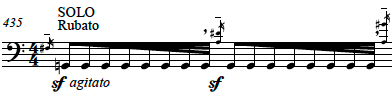
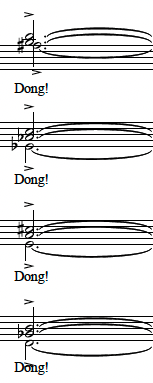
Langer explains in her program notes that she wanted to instrumentally mirror how Lear makes up words, using normal timbres in unusual combinations. So orchestrally we have sliding strings, the always nifty-sounding flexatone, and woodblocks. We have cello cadenzas with acrobatic leaps, sudden pizzicato moments, and accelerating tremolos (with a notation I’d not encountered before, pictured below). We have time signatures capriciously swapping from 3/4 to 4/4 or 5/4, except when we’re in a waltz-y 3/8. Likewise, the key signature or tonality shifts rapidly to align with the mood as the story evolves. Throughout the piece the cellist often gives voice to the Dong — his excitement, his mourning, his madness, and his ultimate obsession of finding his lost love. The chorus swings between a dark narration, pastoral cavorting during the happy days, and embodying the Dong’s lament and searching.

An example of the accelerating tremolo notation, here from the cello’s final cadenza.

Throughout our study of the piece, I’ve found myself fascinated and challenged by three musical ideas:

The three-note near-octave motif. Many of the bass lines have this distinctive and tricky shape, where the top note is a major 7th (i.e., one half-step short of an octave) above the bottom note. This figure occurs, sometimes in a rising sequence, often to represent the Dong’s struggles and madness.

The increasing intervals motif. As the basses tell the story of the Dong searching farther and farther away for his lost love, our melodic line holds an anchor “do” note and then jumps to larger and larger intervals… a minor second and back, a major second and back, a minor third, a major third, and so forth.

Here’s a leap to a fifth, a minor sixth, a major sixth, and a skip to a major seventh before sliding back.

Tone clusters of superimposed major chords. To represent the Dong’s mood — often when he’s angry or confused — the chorus occasionally splits into twelve parts, with each voice anchoring around major triads that aren’t particularly related to each other harmonically. We tune to each other within each group.

The challenge, as with any contemporary music: learn to unlearn

From the very beginning of each rehearsal, James Burton has modified his warmup exercises with an eye towards these musical challenges. We’ve jumped between ever-increasing intervals. We’ve formed chords then shifted to other chords, and fought to hold notes a minor 2nd away from each other. We’ve tried to ingrain that odd major seventh interval into our heads from the three-note motif.

That three-note motif has been particularly vexing — the natural tendency is to sing an octave, not the major 7th. I’m sure many others have also been banging that interval out at home on the piano trying to retrain our brains to hear it, and drawing up arrows in our scores reminding us it’s not as far a leap as we think it should be.

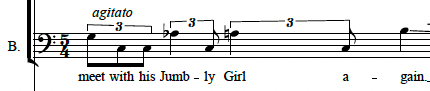
Because the accompaniment is often so active, the spacing of the notes on the page is not always in line with their duration. Couple that with the shifting time signatures, and it’s easy to get lost within a measure. I wish I could say that my ability to read music was impervious to those variations, but alas, I catch myself holding quarters as halfs, treating eighths like sixteenths, moving my eyes too slowly, and getting caught without breaths (see measure 38, below!) As a result, most of my vocal score now has vertical lines marking the beats, and giant checkmarks reminding me when to drop my diaphragm and grab some oxygen, in unison with my section, before an upcoming phrase.

These challenges are further exacerbated by the rhythmic variations throughout the piece. Getting all the basses to stay in sync for what’s effectively a recitative, when it’s jumping between triplets and sixteenth-plus-dotted-eighth… academically we know how to subdivide and keep that pulse, but at our speed and intensity, all too often it’s an educated guess (such as making sure beat 2 & 4 of measure 32, or the first and last notes of measure 36, below, are not counted as triplets.) Let’s just say in the one existing recording of this piece from the London performance, our knowledgeable ears can hear that chorus struggling to agree on some of these rhythms and entrances. You just can’t be on autopilot for any of it — it demands full concentration and a lot of prep work retraining your instincts.

One page of my vocal score, in all its pencil-marked glory

I personally go through the same stages with preparing any contemporary piece. First I listen to it, and recoil in horror at the nonstandard progressions, unstructured atonality, and experiments in rhythms. Then as I slowly commit to the piece, I get a better idea of the composer’s intent, and I begin to marvel at the genius of decisions made to convey story, emotion, and concepts through the context of the music. By the end of it, I’ve fully bought into the performance, I no longer notice quirks or oddities that would startle a first-time listener, and my family and friends become sick of me explaining why it’s such a cool piece.

The Dong with a Luminous Nose is no different — I’ve gone from snickering at the title to discovering its intricacies and now embracing its word painting and storytelling. I hope many readers get to experience this concert, either live at Symphony Hall or on the WCRB livestream this Saturday.

Preparing the Britten War Requiem

Next weekend the Tanglewood Festival Chorus and the Boston Symphony Orchestra are performing Benjamin Britten’s War Requiem. My initial trepidation at taking on this modern piece – for the first time, for me – has been replaced with the familiar joy of being fully immersed in learning a choral work until you feel it in your bones. And given the situation in Ukraine, its inherent pleading for peace is a powerful statement for our times.

But first let me say, what a joy it is to be back to singing again, and at performances for the first time without masks since before the pandemic. Mind you, we could be singing a three part harmony of “row, row, row your boat” on stage and I’d still probably find it satisfying. Taking on this great work is all gravy.

If you’re not familiar with the Britten War Requiem, first understand that it’s fairly recent compared to other well-known choral requiem settings. There’s no classical Mozart or romantic Verdi here! Composed to celebrate the consecration of the rebuilt Coventry Cathedral after its destruction in World War II, the piece premiered in 1962 in England, and with the BSO in 1963. Like many other 20th century pieces, it explores a lot of non-traditional, dissonant harmonies and chord progressions, including using “the devil’s interval” (a tritone) as a recurring motif. What better way to depict the horrors of war? And while you’re unlikely to walk out of a performance humming any catchy melodies, the complex effect of its many emotional, technical, and tonal layers has left many listeners overwhelmed by the experience.

Getting one’s arms around the piece was, at first, a chore. Just learning what connected to what, untangling the odder chromatic passages, and deciphering how on earth were we to get our next entrance from the preceding notes… it necessitated more than a few evenings at the piano or blasting Cyberbass, score in hand, methodically pounding out the notes and singing along. It was akin to intentionally getting lost in a new city until you learn how to get from here to there. Soon, the geography of the piece made sense – not just the flow of the six movements, but their connective tissue. Learning it became much easier with tips and tricks from our choral conductor, James Burton, who regularly pointed out hidden logic to the harmonies or framed the exercise of finding those chromatic entrance notes within an existing tonal progression. He’d have us convert staggered stretto entrances into block chords, or just sing the first note of succeeding sessions, and suddenly what was “how am I going to find that” became “oh, we’re just singing in G minor, down the scale.” He also relentlessly worked with us on deciphering the rhythms: syncopations, hemiolas, time signatures wavering between 3/4 and 4/4, 6/8 and 9/8, or 5/4 and 7/4… the distinctive elements of its unique sound.

As we head into our tech week and begin working with the maestro (Sir Antonio Pappano) and the children’s chorus, I feel like I finally have the whole piece in my head. My score has pencil markings all over the place: circles and arrows to show me where to get certain notes, vertical slashes to help me keep track of the beat when time signatures change, and tips from James on how to approach sections. My pencil even yells at me to “Count!” and “sing longer” and even “Ignore Greg!” — the last because to my right is a Bass 1 who has sometimes been asked to double tenor entrances, which kept making me think I’d missed an entrance. More importantly, getting all the technical details down means we can start moving past them to the emotional content: the pleading of the Libera me, the fury and destruction of the Dies irae and Confutatis maledictis, the sadness of the Lacrymosa, the peaceful rest of the finale. Let me tell you, the moment in the quam olem Abrahae, after the chorus has sung about God’s promise to Abraham, and then the Wilfred Owen poem diverts from the Biblical story with “But the old man would not so, but slew his son / And half the seed of Europe, one by one” is just chilling.

We’re all looking forward to a great performance of this masterpiece and taking the audience on that emotional journey with us.

Happy 50th Anniversary, TFC

Today marks the 50th anniversary of the formation of the Tanglewood Festival Chorus, the chorus I’ve called my home since 1998.

Right now I’m sitting here in our den, listening to a WCRB broadcast from October 2018. That night I was on stage with the Tanglewood Festival Chorus singing an Einfelde meditation, followed by Mahler’s Resurrection Symphony (one of my all-time favorite pieces). Listening to the performance warms my heart… as did the virtual toast with 50+ past and current chorus members before the concert.  Together we raised a glass in celebration of all the chorus has accomplished in five decades.

The TFC is special to me. It’s where I met (and later proposed to) my beautiful Tangle-wife. It’s dominated my Decembers for 22 Holiday Pops season. It’s been the destination for countless “adult sleep away camp” summer trips, first by myself, then with my wife, then with our kids. It’s given me a musical focus and an outlet for the creative side of my brain. And this year, by volunteering as the chair of the TFC Committee, it’s become an even more integral part of my life. So the chorus’s 50th milestone can’t help but be a special occasion for my family. It would be a privilege just to sing one concert on stage with the Boston Symphony Orchestra at Symphony Hall or out on the Tanglewood grounds… and now my “privilege” is showing, because I’ve lost count of the hundreds of times I’ve mounted the risers to make music with this ensemble.

Today is also a special day for many TFC members and alumni who came to the chorus through John Oliver, the founder of the chorus who led us for 45 of its 50 years, as it’s also the anniversary of his death two years ago. I’ve written extensively about John’s influence on all of us, and how much he personally meant to me as a gateway to choral singing, a philosophical muse , and a musical north star. Many of us owe so much to him for the guidance he provided, both musically and personally. We will always cherish his memory and an underlying foundation for the chorus’s spirit.

Now, under James Burton’s leadership, the chorus’s story continues. We are all growing musically and finding even greater fulfillment through our performances.  The chorus’s reputation is growing, earning us opportunities we’d never had before to sing unaccompanied (or lightly accompanied) on the Symphony Hall stage, or even on the main stage at the Shed.  As a choral unit, we’re pushing our envelope to achieve a precision and uniformity of sound, even when singing for what were once throwaway Pops concerts. The culture of continuous improvement is spreading. I have high hopes for what we’ll achieve in the next decade and beyond, and I’m looking forward to being a part of it.

Because of the global pandemic, we did not get to celebrate the 50th anniversary as originally planned, with a performance of Rachmaninoff’s Vespers as quasi-Easter vigil service out at the new Tanglewood Learning Institute. Like many other events during the pandemic, no doubt it’ll be rescheduled so we can more properly mark the moment. But until then, the broadcast performance, the toasts, the shared memories and reflections, and our “happy 50th” cake will suffice!


Don’t want to leave “On Leaving”

This weekend we are performing Shostakovich’s 2nd Symphony again, as part of the Boston Symphony Orchestra’s efforts to record the full cycle of Shostakovich symphonies. But the piece I’m more looking forward to luxuriating in is Grigorjeva’s “On Leaving,” a mostly a capella modern composition influenced by 15th-17th century traditions of Russian polyphonic singing and sacred poetry.

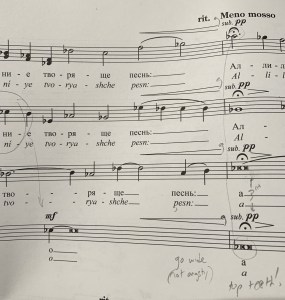
You may not be familiar with this composer – I sure wasn’t. Galina Grigorjeva was born in Ukraine in 1962 but now lives in Estonia. Her works often highlight polyphonic layers and Slavonic sacred music, and “On Leaving” is no exception. While the piece briefly features a tenor soloist, a flautist, and some triangles, it is primarily a showcase for the chorus, given its pervasive atmosphere of ancient monk-like chants. She sources the text from prayers in the Orthodox church service book, “[…] on the Hour of Leaving of Orthodox Souls” and “On Burying Lay People.” Though the text is Russian, it might as well be Latin; it has underlying meaning but functions more as a vehicle for the sustained harmonies and interwoven rhythms.

img_6233

Mechanically, the piece demands a massive amount of concentration and intelligent breath control. It’s been a long time since I’ve counted to 8 for double whole notes in a piece, but long quasi-measured phrases call for it several times. Our conductor, James Burton, warned us today not to be fooled by so many white notes — producing them (and handling the breathing) cannot be boring. Each sustained note has to have a direction and a meaning within the local phrasing as well as the overall direction. He’s worked meticulously with us to make sure we are vertically tuned and aligned, that our counting and cutoffs are crisp, and that when we breathe, it’s with intent and purpose.

The combined effect of these opulent, sometimes discordant arrivals is the creation of an astoundingly beautiful meditative space. Even in the more somber parts, the beauty shines through; James described them as “like a dark cloud covering the sunny day.”

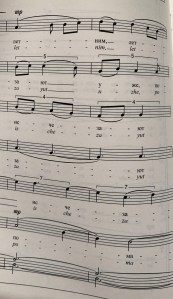
img_6235The second movement in particular is challenging (except for us basses, who have the luxury of holding pedal tones throughout). Parts overlap in rhythms of 4’s, 5’s, 6’s, and 7’s to create this many layered buildup of individual phrases stacked like warm covers on your bed in the winter. It reminds me very much of the second half of Part 7 of the St. John Passion by James MacMillan, a composer who also favored melismas and stacks of voices at different related rhythms. In both cases, the singing complexities lead to a transformative effect that’s hard to describe. It overloads your brain so that you stop perceiving individual lines and exist instead inside an expanded head space.

One other note worth mentioning. In our final piano rehearsal, we reached a moment where the chorus fused tightly together, as if we broke through the copious notes and adjustments and aligned to express the piece as a unit. It was exhilarating to finally reach “flow,” not just for this piece but as a chorus as a whole – the last time I felt that strongly was during the Pizzetti prelude performance two summers ago. James praised us for it afterwards, momentarily dropping his focus on technical fixes to encourage us to search for that moment again in performance. And personally, I love that we got far enough past the technical corrections to earn some coaching on how to distill the soul of the composer. There is a spirituality that this piece can’t help but communicate. We are going to change at least one audience member’s life when they witness this piece. I’m looking forward to it.

(We’re performing on Thursday, Friday, Saturday, and Tuesday evenings, though the Grigorjeva piece is not on the program Friday night.)

Peace on Earth

I’ve never been so physically affected by a piece as I was by listening to a stunning performance of Schoenberg’s Friede auf Erden. 

This Sunday marked the closing concert of the Tanglewood 2019 summer season, and per tradition, it included a rousing, crowd-pleasing rendition of Beethoven’s Ninth enjoyed by all.  But that piece was prefaced by a first: the chorus singing on the Shed stage unaccompanied, with our chorus director James Burton conducting.  It was a reprise of Friede auf Erden, the closing number for the Friday prelude concert that I had missed. I was determined to hear it up close. So I waved my chorus pass in the faces of ushers and grabbed a good spot in the back row seats.

The piece is unrelentingly challenging for a chorus to sing — so much so, that Schoenberg was forced to write an instrumental accompaniment to support initial chorus performances. The tonality of the piece is constantly swirling, in complex voice leading dances that literally measure by measure transform from one harmonic space to the next. Triads are superimposed atop other triads.  A note that’s the third in one chord suddenly pivots in context to become the fifth of another.  The recurring word Friede has a theme that’s an odd but distinct juxtaposition of major chords.

Before the concert, I had experienced only brief flashes of the piece through some additional rehearsals that our conductor had arranged during my previous residencies.  He intended them as a jump start for choristers singing in this residency, but non-participants like me could join in. Those sing-throughs reminded me of the parable of the blind men trying to describe an elephant. As the parable goes, since each can only feel one part of the elephant at a time, they can’t truly explain or understand the whole beast. In those rehearsals, James often broke the piece down into two to four measure chunks, and walked through the extensive theory behind the phrases in each part. Here the basses were in one tonality, but pivoted two measures later to a related tonality as flats became sharps.  The sopranos get their entry note here, from this tenor note there; the altos and basses should target tuning to this perfect fifth like so, because they’re leading the way for the other voices to turn the dominant into the new tonic, and so on. James patiently (and excitedly) talked through the harmonic logic like a magician showing an apprentice where to hide the foam balls to make the trick work. I walked away from that with an appreciation of the complexity of the piece… but I only got to feel the trunk and the tusks.

With translation in hand, I sat with rapt attention and quickly lost myself in the piece. An MRI on my brain would have shown it lighting up all over, trying to keep pace with the harmonies, but also suddenly appreciating the powerful story being told. Divorced from the clinical this-then-this nature of the rehearsal segments, the totality of the piece consumed my cognition. At the warmup, James told the chorus singers that above all, they should move the audience. Fully concentrated on what I was hearing, I was subsumed by the emotional subtexts and subtleties that I had no idea were buried in the twists and turns of the harmonics. Somehow James and the chorus were bringing them out.  My invisible internal objects were fully connected as dissonant counterpoints became dramatic storytelling.

Then, at the closing lines of the piece…. how do I explain this? As the powerful choral forces climaxed and came into alignment with a brilliant D major finale, my shoulders started uncontrollably heaving.  There were no tears in my eyes, but my upper body just sort of began convulsing as if I were sobbing.  I felt so shaken by the enormity of the anti-war, somewhat naive message of hope: denouncing the complexity of our world and its faults, the bloody swords and shameful behavior of its population, with angels pleading for us to return to the Peace on Earth message they proclaimed at the Nativity, and us unable to get there on our own… but that some day we will get there, and that peace will once again be glorious. I was overcome for a few moments by the beauty and futility of it all right before the applause started, and then as the applause died I had sort of an aftershock as I returned to our family’s picnic spread.

To my wife, and all the other chorus members of that performance: all the hard work you put into perfecting those chromatic turns, aligning vertically with other parts, chanting text in warmups together, and pushing to get that last 5% of performance perfection… know that it was worth it and you achieved something monumental.  I can’t speak for what Beethoven-loving Romantic-era-craving audience members thought of it, but I was deeply moved. Congratulations.

Suffering, oppression, and struggle

Russian Soviet Army Fur Military Cossack Ushanka Hat (Black, 60 (L))страданье, гнет, and борьба!  The Russian words for “suffering, oppression, and struggle” sum up the Russian gestalt, as my good friend the Crazy Russian Dad confirmed. (He also suggested the chorus buy and wear these Ushanka hats, but alas, I don’t think they meet the summer dress code.) That is the world we’re entering as our chorus finalizes its preparation to sing Shostakovich’s 2nd Symphony on Friday evening at Tanglewood.

Both our Russian diction coach (Olga Lisovksaya) and BSO conductor Andris Nelsons spoke to us about the Soviet legacy, since both grew up under its shadow. They recounted the brainwashing in schools insisting that Lenin was the country’s god and savior. The two implored us to get past the distasteful propaganda-heavy text and sing the music for what it was. But honestly, I didn’t think that was too hard. Every time we sing a piece we are acting, whether we’re pleading to be spared God’s wrath, gluttonously worshipping false gods, or sadly bidding farewell to our maimed star-crossed king.  Heck, for Holiday Pops, Christian chorus members sing joyful Hanukkah songs and Jewish chorus members sing reverently about the Nativity. Is this that different?

This symphony, however, is odd. The composition includes some “abstract music” with unusual layering effects. It was commissioned to celebrate the 10th anniversary of the October Revolution.  Shostakovich himself didn’t like the results, calling his 2nd and 3rd symphonies “completely unsatisfactory,” as he struggled setting the words to music.  The piece itself is rarely performed, unless a group (such as the BSO) decides to do a Shostakovich cycle. In fact, our choral scores were assembled just for us: the Cyrillic transliterated, the music photocopied, the pages spliced together from disparate parts. 

Having somehow dodged performing Stravinsky’s Les Noces and Prokofiev’s Alexander Nevsky, I finally had to learn how to pronounce Russian consonants and vowels that don’t exist in the English language (hint: it’s all in how you palatalize your tongue). I learned to be a good little Soviet who can sing the praises of Ленин and his revolution. 

If you’re listening this Friday night, here’s what to expect during these 20 minutes. The first section reportedly represents the chaos before order emerged, as clusters of instruments compete for attention. Then, there’s a meditative section described by Shostakovich as depicting a child killed on the streets. After that, more funky music including some beautiful solos.  And then the triumphant propaganda of the Oktober Revolution by Lenin, jarringly introduced by (I kid you not) a factory siren. In fact, Andris and the orchestra are still debating whether the siren should go full blast or stop at an F# for us to tune to.

While it won’t go down as my favorite Tanglewood performance, it’s been fun to lean into the role of devoted proletarians. At one point, Andris told us he didn’t think we were capturing the fervent adoration of the cult of Lenin when we shout his slogans before the finale, so he gave us this direction in his halting English: “I haven’t partaken of this, but… you know that new cannabis store that opened by the highway, with lines of cars around the block? Act like you’ve been there.” That’s right, baby… we’re high on Lenin this Friday!

What to expect in this Verdi Requiem

If you’re a Verdi Requiem fan and are attending the performance tonight (or listening to it on streaming), what should you expect from a performance led by Andris Nelsons?

It won’t be the wildly varied performance led by Maestro Montanero at Tanglewood six years ago. Nelsons is steady and efficient with his tempi, with predictable accelerandos and allargandos, taking space where it’s needed without luxuriating in the gaps.  He lets the Verdi’s composition bring the drama, rather than indulging in it himself.

It won’t be the deliciously dramatic affair six months before that, led by Maestro Gatti, with his choral tricks to help us achieve the effects he wanted. In the prep work, Nelsons presented very few wacky innovations or interpretative variations to make the piece his own. Sure, he wants to evoke terror and desperation in the Dies Irae, to evoke solemn prayer in the Agnus Dei, to evoke tragedy and loss in the Lacrymosa, and a sense of wonder for the Great Amen to close the second movement. That’s all good in my mind — these choices aren’t revolutionary, they’re true to the Verdi Requiem.

In other words, what you should expect is a well-executed, traditionally realized, solid performance of a piece for the ages.

A few places where fans of the Verdi Requiem may notice something special:

  • Vertical tuning. This is an area that our choral conductor James Burton always emphasizes, but I think it makes a noticeable difference in the a capella sections. It’s the mentality of “don’t just sing your note – listen to the other parts and tune to a B-flat minor chord,” or “as the root, you’re the fifth of this inverted chord, basses, so tune it higher.”
  • Stronger marcato on the Dies Irae moving parts.  Nelsons took extra time with the descending voices, and the orchestra parts that double them. He wanted to ensure that in the iconic Dies Irae chant, they swing through with stronger weight at the end of the phrase.
  • A deeper Libera me chant. The one innovation that Nelsons gave us is something I’ve never seen or heard before in six concert runs. He asked any basses who could go down the octave during the restless chanting in the opening of the final movement to do so… and not to restrict ourselves to pianissimo. It certainly gives it a weightier, darker sound.

As for the soloists, I’m a big fan of Ryan Speedo Green, and the gravitas and power he brings to the bass part. The four of them have strengths and weaknesses, and were still learning to be an ensemble together during their first run through on Friday. Hopefully they’ll earn more praise than criticism in the inevitable reviews.

Choir dynamics and hula hoops

Performing a piece like the Verdi Requiem is an exercise in extremes. To meet those extremes, the chorus must stay closely connected — a tough exercise that’s reminiscent of a frustrating hula hoop team building exercise.

Verdi, embracing the Italian stereotype, composes everything over-dramatically using severe contrasts. (You can almost see him wildly gesticulating with his hands about how loud or how soft he wants each section to be.) When first performed, critics said his Requiem was too much like one of his operas instead of a sacred piece. Look at any part of the score and you’ll probably see the chorus told to sing either pianissimo or fortissimo.  Sometimes even ppp or fff.  Sometimes even ppppp!  And even then there are internal gradations… it may say pp in one phrase, but then say düster (darker, more melancholy) or “a little less so” or some other direction in color or tone to show yet another contrast.  And don’t get me started on the subito piano moments when you suddenly drop from loud to an intense quiet.

Loud is relatively easy for a choir to do together. The tricky part is to not oversing and to listen to each other rather than “leading.”  The conductor then balances the orchestra volume (because when it’s orchestra vs. chorus, the orchestra can always win.)

But quiet… quiet is another matter entirely, especially given the heavy orchestral scoring which often features lots of brass.  It’s way too easy to sing, as some have jokingly called it, mezzofortissimo.  Yeah, you know this is supposed to be quiet, but hey, I can barely hear myself over others, so maybe a little louder… a little louder… until those dynamic contrasts are washed away by a middling volume.

It reminds me of the hula hoop team building exercise I mentioned. Now when I say “team building,” what I really mean is “team shattering,” because the first stage of the exercise usually devolves into everyone yelling at each other. Everyone stands in a circle and holds out pointer fingers, and a moderator balances a hula hoop on them. The goal is to lower the hoop as far as possible, without it ever losing contact with a teammate’s fingers. In practice, what happens is the hoop keeps getting higher and higher because you always feel like someone else (the singers next to you, the orchestra) is going higher than you, and you feel compelled to correct for it.

The only way to successfully get the hoop lower is to work together, to trust that others are doing what they’re asked to do, and to communicate and coordinate clearly.  What a coincidence – that’s how to maintain a pianissimo against the desire to produce a louder sound.

During our chorus’s initial piano rehearsal of the week, it felt like many of our pp‘s had become mp’s and that we weren’t getting enough contrast. But by the first orchestra rehearsal, we achieved the feat of being told we were too quiet for one passage. (The solution was not to sing louder; rather, Andris Nelsons held back the orchestra even further.) We have plenty of other places, however, where our mezzofortissimo is showing. That means more ensemble work needed before Saturday to get that hula hoop moving in the right direction.