Category Archives: Uncategorized

Preparing for Maestro Tovey’s Brahms Requiem

“How many of you have sung this more than 10 times before?” asked our assistant conductor Bill Cutter in the middle of our second weekend rehearsal.  A good 30+ hands shot up of the hundred or so choristers assembled.  “And that’s the problem,” Bill said with a grimace.  He admonished us (correctly) that too many of us were mailing it in, and not seeking that deep connection we need to have with the music.  Bill did an admirable job not letting us sit back on our haunches and forced us to reconnect with the text and the meaning behind it.  We needed a little flexibility, because Bill’s direction didn’t always match what the grizzled veterans were used to for this piece.

That’s going to be incredibly important, because every performance of the Brahms is very different.  And we don’t really know what to expect heading into Monday night’s piano rehearsal with Maestro Tovey.

My wife sang with Tovey for the chorus’s performance of Porgy and Bess.  Neither of us sang with him for his return to the chorus with Candide this summer, though everyone raved about what a fantastic performance it was.  Tovey certainly has a flair for turning musicals into crowd-pleasing concerts.  I was fortunate enough to sing with Tovey for the Lobgesang, and see a bit more of his joie de vivre at the chorus holiday party afterwards.  He was the life of the party even before the afterparty, because on the podium, Tovey is full of positive energy, humor, and gusto.  Here’s what I wrote back then:

Choristers who sang for Maestro Tovey in the Berkshires for last summer’s Porgy & Bess often gushed about how great he was to work with: personable, musically knowledgeable, and able to clearly communicate what sound he wanted from us. Those of us experiencing Tovey for the first time were not disappointed. He immediately set to work identifying the moments of drama that were hidden in plain sight, and gave us concrete tempo and dynamics adjustments to highlight them. He added personality to the pedestrian, directing us with words like “warmth” and “beautiful” and “prayerful.” He challenged us to embody the reverence and joy and relief from pain that lay beneath the surface of the text. And he did it all with a wink and a laugh that quickly earned the fierce loyalty of the whole chorus. One couldn’t help but want to sing for him and to deliver what he asked from us. We became committed to his vision of the piece, long before he endeared himself to the group at Saturday’s winter chorus party by joining the jazz band and hitting the dance floor.

Come performance time, Maestro Tovey continued his outstanding leadership at the podium. He was animated, demonstrative, and inviting in his conducting. At no time did the chorus really feel we were competing with the orchestra’s sound, with Tovey holding the reins. Through it all, we successfully captured and conveyed the piece’s character and intensity.

It’s hard to imagine the happy-go-lucky, musical showmanship of Tovey applied to a Requiem.  But this isn’t a sad Requiem… it’s a celebration of the living.  It’s a service for the living, not the deceased.  It’s victory and power and mocking death’s inability to triumph in the end.  It’s reflective peacefulness and the blessings of your friends and family that let you keep carrying on.

So I fully expect Maestro Tovey to take us on quite a journey. Where Maestro Dohnányi was about philosophy and precision, Tovey will almost certainly be about color and emotion.  Though they’ll both share the same directive: to rejoice in our lives even as we comfort the mourners.

Brahms Bingo

John Oliver is not going to be available to prepare us for our upcoming Brahms performance.  (Assistant conductor Bill Cutter will be doing the honors.)  This may not be that big a deal, given that at Bill’s preliminary rehearsal, I saw fewer than 10 hands raised when Bill asked who hadn’t sung it before.

This is only too bad because I had been planning to make a 4×4 “JO Brahms Bingo” card for rehearsals this weekend, using the 16 coachable comments that I expected from him during the run-throughs.  That’s because, having sung the Brahms with him 3 times now (twice with TFC, once with MIT), I’ve gotten used to many of the particulars he emphasizes.

None of it truly matters once the conductor arrives and adds his own personal stamp to our performance.  But anything he doesn’t change becomes The Way We’re Doing It, and I like that.

So here are the minor moments I love in John Oliver’s interpretation of the piece.  Many are already indicated in the score; much of this won’t mean anything to those not intimately familiar with the piece.  And Bill will likely not observe them, as he has his own technicalities to pursue.  But it’s how MY favorite Brahms Requiem goes.

Movement I

1. Making that first entrance (and later recap) as light a touch on Selig as possible

2. Two /t/ — Articulating lied tragen and und tragen carefully

3. Getting in and out quickly on the selig swells, to match the brass

Movement II

4. The darker tone, legato, and double consonants of denn alles Fleisch

5. The flinging sensation of spitting out wird weg

Movement III

6. Aspirating the /h/ and rolling the /r/ for movement III’s opening  Herr

7. Each Nun Herr sounding like two bell peals ringing out

8. The stentando keine Qual finish to the fugue

Movement IV

9. The piano espressivo melodies for the tenors and basses

10. Sempre piano for the recapitulation

11. Stepping back to become the accompaniment for the orchestra at Wohl denen

12. The all-important agogic accent, separation, and subito piano before the final immerdar.

Movement V

13. The prayer-like intonation and cadence of einen seine Mutter each time

Movement VI

14. The drudgery and step-by-step plodding of the opening Denn wir haben, like dragging yourself home after a long day of work

15. A big separation and subito piano right before the next to last Ehre und Kraft

Movement VII

16. Attacca this movement, sopranos be damned.

Distilling the Soul of the Composer

At a Tent Club Q&A session on Wednesday, someone asked our conductor John Oliver, “What is the purpose of the conductor?” Rather than focus on the mechanics, like “beating time” or “keeping everyone together,” John’s answer was more profound. “The purpose of the conductor,” he said without even pausing to think, “is to distill the soul of the composer, and give it the orchestra, chorus, and soloists so they can communicate it to the audience through the piece.”

Throughout my stay at Tanglewood this week, I’m finding many applications for that statement during our rehearsals as we prepare two Verdi opera excerpts and Mahler’s “Resurrection” Symphony.  It applies at three levels: the mechanics, the emotions, and the message.

The Mechanics

At an almost superficial level, it’s about what the composer wanted tactically within the music. Our conductors have been excellent at giving us technical details to further their interpretations.  Maestro Honeck is very clear about the placidity he wants at the chorus’s entrance in the Mahler, asking us to dramatically de-emphasize all the German consonants and maintain even dynamics and flow — it goes against all our instincts for singing German!  Maestro Lacombe for the Verdi has worked intensely with us to capture the character of each chorus, which is particularly tricky given Aida has bad-guy priests demanding blood, broken prisoners pleading for clemency, and victorious citizens celebrating.  He’s made the priests’ sound darker and more biting.  He’s asked us in the prisoners chorus to watch him closely for rubato to better shape our cry for pity.  He’s turned the people’s chorus into a baseline for the other choruses, asking for precision in consonant placements and dynamics, while bringing out subtle rhythms to maintain the driving pulse of the piece.

All of these adjustments are de rigueur for the week of Tanglewood.  I’ve always accepted them as part of the process, as the means by which the conductor shares his vision of the piece with us.  But never before have I done so with the broader purpose in mind; that if the conductor is giving us his interpretation, who is he interpreting?  It’s not just the notes and dynamics on the page, it’s what the composer wanted when he captured that music onto paper.

The Emotions

At a deeper level, it’s about the emotional interpretation of the music and what we want to deliver.

The lovely melody of Va, Pensiero from Nabucco is deceivingly simple, and it’s easy to get carried away lustily singing it.  Remembering that it’s a chorus of Hebrew slaves lamenting their exile from their homeland tempers that notion.  Mechanically, you sing more sotto voce, you shape phrases to avoid outbursts, you hold back until the third stanza’s fortissimo to give more impact to your lament to the fate-seers about times gone by.  But that’s all in service of the emotion.  Emotionally, you need a hushed reverence, an unquenched longing for what cannot be, that must carry through the entire piece.

The Mahler is all about emotion at the end, and I’ve written before about the musical orgasm of the finale, as you pour forth every ounce of your being into a joyous crescendo, a tidalwave of sound that overwhelms the audience.  We will rise again!  It’s almost impossible not to be affected listening to this piece.  My wife and I get goose bumps in the car just listening to a recording.  Here, too, though, there are subtleties before that moment, which Maestro is giving us.  Rubato again, but to signify the wings we win, to the point where we can visualize a feather darting back and forth in an uplifting wind.  The utmost silence of the opening is now a vehicle for the soloist to rise out of, her part splitting from the chorus and ascending just like the resurrection we sing about 5 minutes later.  Lots of neat colors are being painted with the music that I’ve not experienced as part of this piece before.

The Message

At its deepest level, I’m realizing how important it is to study the composer himself; what his life was like, the circumstances of his composition at the time, his comments about the work to peers. I’d always enjoyed reading about that anyways, purely out of my own interest. But I never really consciously consumed that with the intent of better delivering the message to the audience.

Verdi’s wife and small children had just died when he wrote Va, Pensiero.  What mindset must he have been in to pen this song of loss of one’s love, be it country or family?  How was he representing his loss through the chorus of the Hebrew Slaves?  

Mahler was obsessed with death; it’s no wonder the first movement of the 2nd Symphony is this threatening, funereal march to the grave. Moreover, he was a Jew who converted to Christianity. Before that conversion from Judaism, there was no afterlife for him. So the 2nd Symphony’s emotional center is the 4th movement’s “Urlicht” about the promise of heaven, before he celebrates that resurrection in the final movement, first quietly and then with raucous joy.  The music’s emotion is unmistakeable, but in the umpteen times I’ve performed this piece, I’ve never thought about the childlike wonder of a composer who is exploring, perhaps for the first time musically, the concept of salvation from the death he had brooded about for the first half of his life?

Artist’s interpretation

Somewhere while wandering through art museums, I picked up a notion that I hadn’t heard before: once a work of art is submitted to the public, it is no longer about what the artist intended when he created the work.  It is about the art community’s interpretation of the work.  Never mind what Picasso had in mind whenever he painted bizarre portraits of his lover–he relinquishes ownership of its meaning.

Perhaps that is as true in music as it is in the visual arts.  But since music is digested through performances, there is a more active element involved, one that mandates a translator.  The conductor is our view into the composer’s soul.  I can only hope to be a contributing puzzle piece to achieve that vision and bring people into the moment, to extend that composer’s vision to their lives.

John Oliver Master Class, April 2014

These are my notes from the Master Class which John Oliver held on April 6, 2014, in the chorus room at Symphony Hall for selected members of the Tanglewood Festival Chorus, with Martin Amlin the excellent piano accompanist.  John went out of his way to pick younger singers, telling us that they were often the most interesting to hear but often had the most to learn.
 
In these notes I’ve focused on capturing the advice rather than the praise.  There was plenty of praise to go around.  In fact, all the singers should be commended just for standing up in front of everyone, let alone doing such a great job performing and then taking further direction.
 
Kendra Nutting, alto, Claude Debussy, “Beau Soir.”
  • “The best rehearsal is in performance.”  Everything should be louder, not pulled back because we are here in our rehearsal room. Maintain the line and the flow from the very first opening measures so you can find that resonance immediately. By example, John Oliver explained that Birgette Nelson would always be blasting away with her resonance whether she was on a stage or not. 
  • “Make sure the tone starts in your mind before you make a sound, so that the note from the get-go is fully resonating.”
  • “Make sure this other note is ‘part of the flow of lava.'”  Here John focused on a specific phrase where the upper note didn’t have as much power.  Upon repeat, we heard a much stronger note that had twice as much resonance! John cautioned about not forcing the voice into something it wasn’t ready for, which is dangerous for a young voice.  “But the voice is ready. You just didn’t know to do it.”
Patrick McGill, bass, Gaetono Donizetti, L’elisir d’amore, “Come Paride vezzoso”
  • Tenors and low notes.  As the male voice gets lower, it has to stay more open, “and your tendency is to take that tightened focus — the one you know from your upper middle range — and keep it all the way down.  And that cuts you off, like in that run that goes down to the low B-flat.  Experiment to get that freed up.”  Upon repeat, it sounded much better.  “Now, it doesn’t sound like you’re stretching to get down there.”
  • Coloratura.  “The tendency is to let the notes go up and down, and it’s important not to let the notes go up and down.  Let one note take place after the other, let every note lead, like you have a tube they’re all going through.”  On repeat, we could hear all the notes much more clearly and cleanly.  When he then got to the high E, John noted that “he was already in line and ready with the proper resonance.”
Bethany Worrell, soprano, Igor Stravinsky, The Rake’s Progress, “No Word From Tom”
  • Horizontal, not up and down.  Similar advice as for Kendra to carry the line forward.  “You were all taught up and down, and that’s not it for the singing instrument. It’s flow, it’s horizontal, that you should be concerned about.”
  • On maturity.  “How old are you?  29?  You’ve got another 10 years before your voice fully comes in in that lower range.” Don’t force the vowel… Second time was much more connected. 
  • Taking time with notes.  “You have this facility [meaning natural aptitude.] But it’s the enemy of singing, when something is so easy.  Take more time with some of the notes.  We can hear them here, but in a theatre or orchestra the audience wouldn’t. Be more gracious with some of those notes, and we’ll all hear the words and expression better.”
  • You can take it with you.  “What are you taking with you from that F-sharp [long note] to the A?  Take the vowel with you to the high note.  You don’t need to re-articulate it.  Then you get the full resonance.”  She tried the passage again.  “2 out of 4, you got it.  It’s something that will require work to make it natural.”
  • Get to the ecstatic.  This section of the piece started right off with a forte high note.  “Make sure you’ve got all your energy on that very first note!”  It’s all in the mind.  Be there, aligned and resonant.  
  • Anchored sternum.  “You have a tendency above the staff to have a slight anchor right here [gesturing to his sternum] which is robbing you of the resonance you need. Stand in front of a mirror and watch.”  John suggested a trick from the last Master Class, of flaring your arms back and opening your hands, to force the chest back up.  “The minute that is tense in the sternum it robs the resonance.”
Adam Van der Sluis, tenor, Ralph Vaughan Williams, “Whither Must I Wander”
  • Just a few lessons.  John revealed later that he had given Adam a few lessons, and before that Adam had never had a formal voice lesson (and may have thought himself a bass).  In just a few weeks, he was now growing into his top notes without as much reaching.  “I don’t teach much any more, but here we’ve put some basic principles in place, and now he has a line and a reach in only a few weeks… and now I need to practice teaching more!”
  • On maturing tenors.  “Tenor usually takes a long time to mature…  to say nothing of the tenor personality!”  
  • Don’t be a pianist.  John repeated his oft-heard advice about not singing like a pianist, plunking one note after the other.  “As a pianist he thinks like a pianist.”  In particular, he mentioned getting into your head that “diphthongs should not be two parts.”
  • Singing loudly.  “In general, you should sing louder.  I’ll warn you if you’re forcing it.”  Just a little more volume makes the tone coalesce more.  John cited another singer’s advice [I missed the name… anyone there know?]  “Sing forte for the first 4 years.” Don’t spend time learning how to sing correctly, explore your voice and instrument first.  
  • Singing with strength.  “Sing through the lower part of the passage, and don’t back off in any way, so the next high note that comes is right in line.”
 Stefan Sigurjonsson, bass, George Fredrich Handel, Messiah, “The Trumpet Shall Sound”
  • Tensions.  You must always guard against tensions that creep in, like little gremlins.
  • Popping up the sternum.  “The relationship from here to here,” John said, gesturing from the sternum to the base of the ribs, “it should be inflated, with the sternum like a balloon. Good singers, when they have a high C, that sternum pops up.  You have pressure downward there instead.”
  • Relax the face.  “Watch for tensions in your face, especially when you’re concentrating. Sure, the Last Judgment is nothing to grin about, but make it more magisterial than disapproving!”
  • Hook and a string.  “You should feel like there’s a hook and a string pulling your sternum forward on those long top notes. I hear a smoother legato and the high notes more connected the second time.  But you should try some mirror work to say, ‘Oh god, I didn’t know I was doing that.’ “
 Jon Oakes, tenor, Gian Carlo Menotti, The Old Maid and the Thief, “When The Air Sings of Summer”
[Note: Jon is a lifelong pianist but has only been singing for the last two years.  I’m sure he must have felt intimidated, as I did, after some of these heavy hitter born-to-sing performers went earlier!]
  • Singing is boring!  “You must get tired of me saying the same thing over and over again. Singing is a boring thing, you have to do the same thing over and over again!”
  • Staying connected.  “You have to be connected to the air, and the words have to connect the line of tone.  The way he’s currently singing is as if the violinist only played one note to a bow, instead of ten. Your musical instincts are so good that a lot of the problems it introduces are covered up. When you think of the line of words as all connected to each other, going out through these resonances here…  then take another breath and keep the bow on the string for the next time. 
  • Breathing in the right places.  John Oliver suggested some better places to breathe to keep certain phrases together, and urged, “You have enough breath to make it!”  (“Do I?” worried Jon.  “Yes!” answered John.)
  • “Conducting.”  “Now Let’s take out the conductor,” said John Oliver, referring to the way Jon waved his hands around a lot while singing.  (“But I liked that!” moaned Jon, to laughter.)  “You can conduct or you can sing; I advise you to choose one or the other.  Look at how it worked for me!”
  • Magic Circle.   “It’s hard to be somebody else. I’ve said it a million times, but you have to step into the magic circle, where you and your neuroses don’t exist any more, just the composer and the character.  It’s a mind trick. I read Stanislavsky, you get in the habit of becoming someone else, and you are not self conscious and not nervous.”  (Jon:  “I have lots of neuroses.”  John Oliver: “Not to be discouraging, but I’ve never gotten over mine!”)
  • Mirror work for finding your character.  “The one other thing I want you to do, in the privacy of your own home: go in front of a mirror and imagine who that person is that you want to be.  You could do it a million ways.  Be angry, be patient, be anything but singing correctly. You can get to that character in many ways.  It’s so important to learn to sing, but again, if you only focus on singing correctly you miss the rest.”
 Laura Webb, alto, Samuel Barber, Hermit Songs, “The Desire for Hermitage.”  
[Note: I in particular enjoyed hearing Laura go from her cute Texas twang into full kick-butt operatic diction-and-resonance mode.]
  • Not trusting what you think you hear.  “There’s a concept that young folk need to hear. You’re listening to your sound and you think you’re hearing it, but you’re not always getting through it to the listener. The moment you begin a word you need to have a hook on it that pulls it through your mouth.  It’s the word itself; its tension is what brings it through the resonance. Otherwise, it sits too much in the inside.”
  • On quiet singing.  “Soft sound still has to fill all the space in the hall. It’s a problem with practice rooms… and with voice teachers, frankly.”  Laura hinted that her voice teachers have told her her voice was too big.  John disagreed. “Sing louder. Find your voice. Better to have too much.”
  • Little notes.  “When you get into little notes make sure you still have that pull on each word. 
  • On poetry vs. musicality.  Referring to one particular passage, John warned her, “You’re singing it well for the poetry, but the music wants something different.  It doesn’t have to be click, click, click… [like a metronome.]  You can make space within the music to communicate the meaning.”
 Meghan Zuver, soprano, Vincenzo Bellini, I Capuleti e i Montecchi, “Eccomi… Oh quante volte”
[Note: Everyone was great, but I think Meghan inspired gasps and the most hearty applause with her gorgeously enunciated Italian and her overall fantastic singing. She introduced herself by mentioning that she managed the Starbucks in Lexington Center.  After her performance, John’s first words were, “Get the hell out of Starbucks!”]
  • Grace notes.  “Don’t skim over the grace notes too fast.  It’s part of the line, it is not just a hiccup on the line. You need to take more time with it.”  They worked until the grace notes sounded “properly Italian,” no longer an after thought.
  • Notes above the staff.  Regarding her high B: “Notes above the staff take place mentally narrower, and you took the weight out of it when you went up there.  All the great singers talk about this.  It’s like a shooting star coming from way up there.”  Upon repeat, she nailed it by adding that brightness, using her finger to point upwards to get the right mental imagery.

Thoughts on TFC Master Classes

This Sunday, John Oliver held another outstanding session in his series of Master Classes for the Tanglewood Festival Chorus.  But in addition to the notes I captured from the class, I wanted to jot down my personal reactions as well.

The singers were all super impressive, in one of two ways:

1) Many of them introduced themselves as juniors or seniors attending Boston Conservatory, or New England Conservatory, and majoring in vocal performance, or pedagogy, or somesuch super-impressive on-the-way-up music-is-my-life dedicated studies, such that I wanted to slink out of the room and never come back.  It’s not that they were bragging about it; all of them were quite humble, almost embarrassed, to put forth the claim.  It’s just that, as I joked with some fellow alumni after the class, the “MIT Conservatory” didn’t exactly have that level of study available — and even if it had, I doubt I would have qualified for it.  And even if I had qualified for it, I doubt I would have pursued it.

These are people who are going deep where I’ve gone broad.  They are experts where I’m Just Another Bass, a dabbler happy to be merely near the same stage as them.  This is not intended as false humility or humble-bragging on my part.  What’s the saying?  “A novice practices until he gets it right.  A master practices until he can’t get it wrong.”  Or the other old piece of wisdom, that as you study a subject, eventually you learn enough to recognize how much you don’t know.  I can see these singers know a lot that I don’t know, and may never truly know.

2) The ones who did NOT introduce themselves as vocal students were impressive, too — precisely because they did not slink out of the room!  They were all clearly a little uncomfortable since they were new to singing, or majored in psychology and history, or were otherwise not in the same place in their musical journey as the others.  But what courage it takes!  For them to ALSO pull together the confidence to stand up in front of ~75 fellow singers and daringly bare their throats to our potential fangs.

And that was my big takeaway.  I’m not going to be auditioning for an opera lead role any time soon.  But it was encouraging to hear others still at the start of their journey.  I was able to take away pointers from their lessons just as much as I picked up snippets of awesomeness from John’s advice to those who call it their craft.  And that made the experience truly rewarding.

Here are the notes I captured for each of the eight singers.

Back in the Berkshires

Today marks the start of my first residency at Tanglewood in two years, this time for the Verdi Requiem performance on Saturday night, July 27th.  I’m grateful to be back, and I’m especially grateful to be singing this piece, even if we lost the opportunity to sing with the next BSO conductor along the way.

It’s very gratifying to be back.  Last summer various conflicts prevented me from even putting my name in for the few concerts that needed basses, so my “exile” wasn’t expected to be permanent.  Still, we haven’t been to even the first rehearsal and I already feel refreshed and energized knowing the week before us.  There’s just something about the experience of being out here for a residency, dedicating yourself to the music, being around like-minded musicians, as well as getting a break from the pace of work and home.  Missing it for a summer made its absence even more prominent.  Having my wife with me for the week, even though she’s not on this roster, makes it even better.

On the drive out, we listened to some movements of last winter’s performance at Symphony Hall with Maestro Gatti.  At one point, my wife asked me if this was my favorite piece.  That led to a spirited debate about our favorite choral pieces, but in the end for me it may be 1A and 1B between this and the Brahms Requiem for pieces that I’ve fully internalized and could probably sing memorized right now if you asked me to.  The upshot of that, though, is that it means–unlike some of my past residencies here–there’s very little homework required.  I just have to show up and be open to a new interpretation so I can realize the collective vision that we’re trying to achieve in the performance.

The person setting that vision, however, is not Maestro Nelsons, after a freak accident where he got a concussion from hitting his head on a door.  Nor will it be the scheduled bass soloist, Ferruccio Furlanetto, who has a bad cold.  While I’m told that Eric Owens is a more than able replacement for Furlanetto, the conductor replacing Nelsons is the relatively unknown Carlo Montanaro, whose Italian descent and operatic experience should serve him well for the Verdi.  Still, all of us in the chorus are of course disappointed that we won’t have an opportunity to meet and work with the next appointed conductor of the BSO.  What can you do?  (Besides ducking faster when a door’s coming at your head.)

I’ll be writing more about Maestro Montanaro and our rehearsals later this week.  We have two 2.5 hour rehearsals this afternoon, and a run-through on Friday morning, before the Saturday evening performance. 

Staying musically engaged during a hiatus

It’s been ages since I posted here — namely because I had a long spell without any official singing gigs.  There were only three summer concert weekends with the Tanglewood Festival Chorus this year — I had conflicts with two of them, and I ceded the third to my wife (you know, the one whose career is singing… remember, I’m Just Another Bass.)  Fortunately, Holiday Pops is coming up to exercise my vocal chords, and even more fortunately, I’m on the roster for one of my favorite pieces, the Verdi Requiem, this January.

But that meant almost 7 months without being on the stage of Symphony Hall or the Koussevitzky Shed.  When I skip any activity for even a few months, my competency decays.  How can I keep up my singing with no singing goal?  The obvious answer is to take some more lessons, but that’s not sustainable on my pocketbook.  It’s tough, but I’ve found a few activities to help fill the gap.

I had the pleasure of singing with my wife’s church choir for their “music Sunday” in June.  They picked 4 choral pieces and several arias from Mendelssohn’s Elijah, assembled a small (but, it turns out, quite impressive) band together of some strings and woodwinds to cover the orchestral parts, and gathered as many occasional singers from the congregation as possible to put it together in a night of practice.  It’d be false modesty if I told you I wasn’t the strongest bass singer there, especially having sung Elijah before.  But the group was pleasantly balanced and it was a joy to sing.  And I, for one, was happy to get some more classical singing in a formal environment that gave me something to practice.

The other interesting diversion which occupied several months of my time was preparing for Otherworld.  Otherworld is hard to describe succinctly; it’s a non-profit group whose goal is to give ordinary people extraordinary adventures.  I’ve been part of the group for 15 events across some 20 years.  Each event is a massive production held at a 4H camp in Connecticut.  How massive?  Around 80 staff members host about 55 participants in an adventure weekend as they become the heroes of an intricately laid out story.  It’s like walking into a book, or finding yourself an actor in one of those dinner theaters.

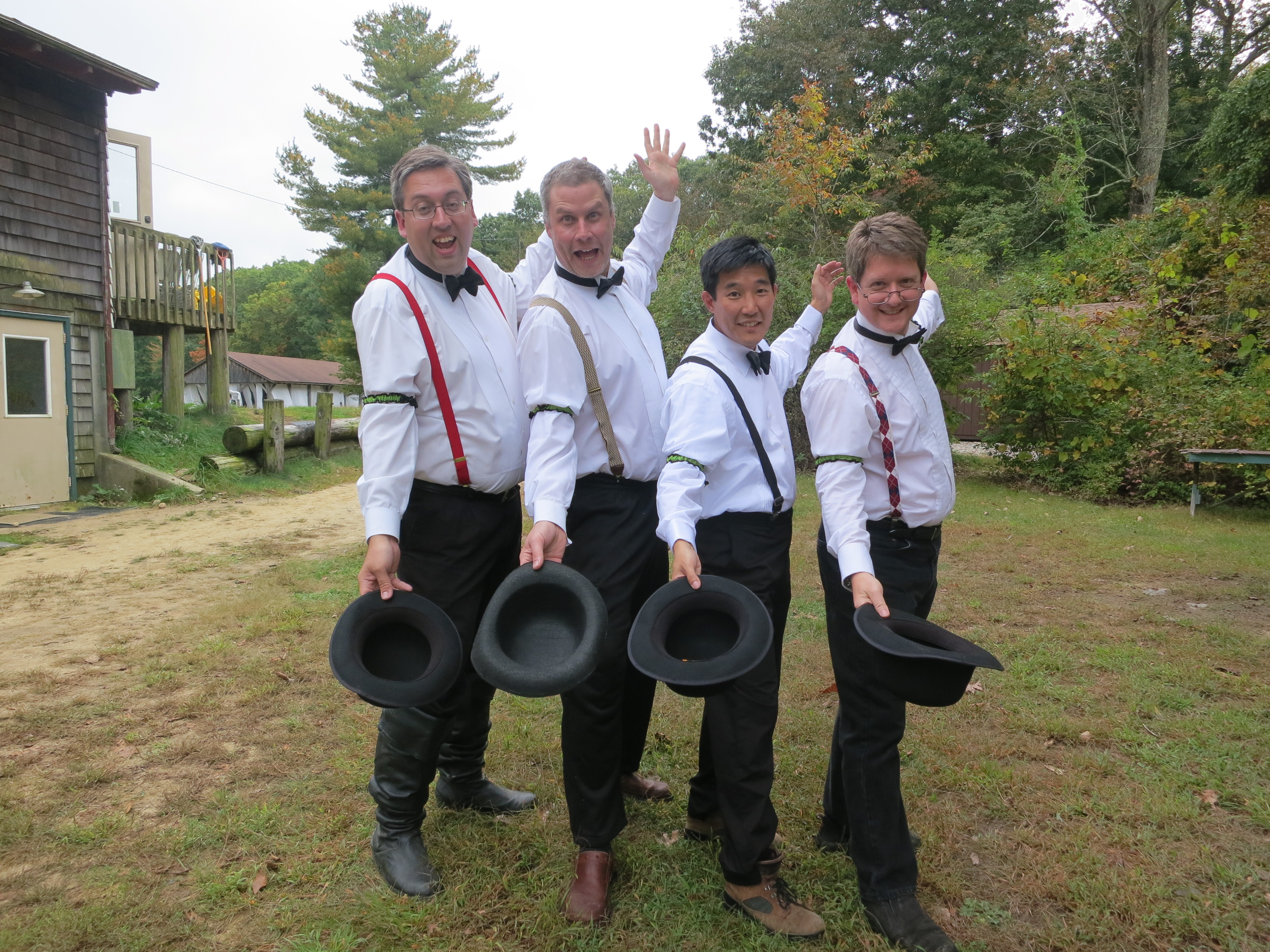
In any case, Otherworld has a significant amount of music in it.  There’s a part where singers hidden in the woods gently sing a Taize melody to make a moment feel magical.  There’s a Big Musical Number (think an Elvis movie or Broadway musical, where in the middle of a scene suddenly people break out into song).  This year there was a Barbershop Quartet–I wish I could tell you WHY there was a Barbershop Quartet, but it would involve too many spoilers for the weekend should you ever decide to come (and you should!).  And there was a part where carolers show up and sing, except they’re singing for a holiday that doesn’t exist in our world (a cross between Thanksgiving and Christmas.)

I had the distinct pleasure of being involved in all four of these musical singing endeavors.  While the Taize had been done in past events, the other three were brand new.  I would arrange a medley of Bob Dylan’s Quinn the Eskimo and the 70’s hit Lay a Little Lovin’ On Me, for a group of singers who wouldn’t all be in the same place together until the day of the event.  I worked with three other singers remotely to identify Barbershop songs that we could learn independently and then blend together, again on the day of the event.  And, I had to compose a short holiday carol.  Each of these with a different group of people on staff.

Sound like a nightmare?  Well, the whole experience was quite exhilarating!

While I enjoy arranging music, having done so for past Otherworld events and for a few weddings, it’s by no means my forte–I’ve seen so many others who can arrange music faster and better than I can.  I probably spent about 15-20 hours of time listening to recordings of the music, first casually during commutes, and then more intensely while trying to map out the song and transfer it into Finale the way I was hearing it.  Getting the transitions in the medley was tricky but I was super-excited when I figured out a way to musically handle it.  I did some test recordings of just my voice on all parts to get a sense of whether my arrangement was working.  I switched midway through from all-male back to a mixed chorus.  Then getting the music into the computer and onto paper for the 8 of us I had singing, and making practice recordings where I would delete some of the parts so people could listen to it on their own.  We then got 5 of us who were local into one place to rehearse, and recorded THAT for distribution and practice… overall it was probably a 50 hour labor of love… and it was all for about 3 minutes during the weekend.  The best part?  It came out PERFECTLY.

The Barbershop Quartet was equally challenging.  Having never sung Barbershop before, I received some tutelage from fellow staffer Chris Reichert, whose “Notable Ring” quartet in Austin has won awards in a few regional contests. He recommended some tags, procured some music and learning tracks (which are awesome — left side, just your part; right side, other three parts), and coached all of us about the style: less vibrato, aiming for a ‘ringing’ on sustained chords, emphasizing the ‘sour’ notes whose dissonances drive the music forward, even such logistics as gathering together to find your opening pitch then spreading into a circle and nailing it.  We were worried because when we first got together in person to practice, we discovered that it’s harder to sing your part with three other people who are also trying to learn their part, as opposed to a recording of three solid singers on a learning track.  But with Chris’s coaching, we made it first to barely passable, then quite acceptable, and finally to knock-people’s-socks-off when we performed.  To untrained singers, we were amazing.  But even singers (and at least one participant who sang barbershop), we were top-notch.  Another case where hours put into a labor of love paid off handsomely, even though we were only “on  stage” for a few hours of episodic singing.

The holiday carol required much fewer hours, more of them spent thinking than composing or practicing.  I needed something that sounded Christmas-y but wasn’t a known carol, and that could be learned by a group of about 12 singers with mixed levels of experience singing — just as you might have at a holiday gathering.  For that reason, I quickly ruled out part-singing.  I ended up taking “Joy to the World” and flipping the melody upside down.  That way, the rhythm was known to the singers, the chords (if there were any) would echo other carols, and the tune would sound vaguely familiar to listeners.  I sang it for a group of friends and it had the desired effect.  So we printed up some sheet music and made little caroling books.  I recorded it on the piano and recorded me singing it, and got a copy to everyone in the makeshift chorus.  The only problem?  The singers were too good!  (The scene called for them getting interrupted toward the end of the chorus by a boorish character who thought they weren’t doing a good job, which leads to another character confronting him, and… well, that’s a story for another time.)

All in all, it’s amazing how busy you can make yourself musically if you look for ways to fill the gap.  And now — onto Holiday Pops and the Verdi Requiem!  The Verdi is going to be AWESOME!

The Schlock of Champions

Sometimes you gotta get away from the formality of the BSO concerts and embrace the cheese of the Boston Pops. Normally this is reserved for the holidays. But I was fortunate enough to get on the roster for a three night series of Pops concerts called “City of Champions” — a star-studded celebration of Boston’s sports culture.

What do I mean by schlock? Our songs include the star spangled banner, O Fortuna, take me out to the ball game (which has verses?!), Heart from Damn Yankees, to be a football hero, we are the champions, an Olympic fanfare from John Williams… Andre Tippett of Patriots fame is narrating a piece. More guest stars have been promised. The whole thing is just way more fun than anyone should be allowed to have at Symphony Hall.

For instance, as i write this at rehearsal today, we sit behind the Drop kick Murphys as they warmed up. We were warned that the organist from Fenway Park would be “warming up the crowd” before the concert and at intermission on Thursday. We were also told not to be alarmed if we heard the T shirt cannon going off.

First concert is tonight. In typical pops form, we had one rehearsal which was the first time many of us saw the music, and the on stage rehearsal is now. Should be a blast!

Critical Reviews of the Brahms

Well, this was another lesson in “don’t put too much stock in the reviewers.”  Our Thursday performance was perhaps one of the better performances I’ve been privileged to be a part of.  Our Friday matinee was also outstanding, though I admit I felt more emotionally connected to the Thursday performance… Fridays was more mechanical, and a little tougher for the chorus to keep the pitch up at the end, no doubt a little vocally weary after singing this twice in 16 hours.

But you wouldn’t believe that based on some of the reviews.

Jeremy Eichler of the Boston Globe had this to say about the chorus:

And of course the hard-working Tanglewood Festival Chorus was in the spotlight for the entire evening. There were a few moments of wayward pitch, but overall these singers achieved a beautifully warm blend and sang from memory with a musical responsiveness that would be gratifying for any conductor. Certainly, as the response made clear, it was gratifying in the hall.

We initially bristled at the characterization of “a few moments of wayward pitch,” but a few chorus members in the audience dutifully confirmed just that: one or two moments of wavering.  Hardly significant, though, and by all accounts did not detract from the full enjoyment of the piece.  If anything, it’s disappointing what the reviewer did NOT mention: the slavish attention to detail with regard to diction and dynamics that produced a clarity of sound rarely heard in any Brahms Requiem performance.

The next Boston-area review, by David Wright of Boston Classical Review, was just a darn shame.  It practically devolved into insulting us.  He *really* didn’t like the performance, calling it “dull” and “a lugubrious miasma.”  And while many of us considered the soprano good but not great,  he held her up as the bright spot…

…on a night characterized by plodding tempos, lax rhythms, congealed orchestral textures, and choral singing that sounded harsh in forte and fuzzy in the softer dynamics.

Mr. Wright also claimed Dohnányi’s performance lacked in Brahmsian energy and warmth, said the Wie lieblich had no gentle sway to it, and claimed the emotional contrasts of the second movement “were grayed out in Dohnányi’s slack, one-tone-fits-all rendering.”  He further writes:

In fact, the entire performance was a cautionary study in how important a firm rhythmic foundation is, no matter what the music’s mood.  Without it, phrases lost shape and direction, ensemble playing grew shaky, crescendos lacked emotional conviction and became just a dialing-up of sound, the chorus’s tone and diction sagged—and, for the listener, minutes began to seem like hours.

To this, most of us say, “Huh?”  It’s hard to understand whether Mr. Wright was in the same Hall as the rest of us.  I could go through and refute each one of his points (except maybe the sagging tone), as each one of them was countered by the specific praise we heard from sharper, more experienced ears than his: non-roster chorus members attending, native speakers who praised our diction, brass at the BSO, orchestra members, and John Oliver himself.  My guess is that he fell into the same issue that I mentioned at the end of a previous blog post: his favorite interpretation of the Brahms Requiem no doubt indulges in more upbeat tempi, more swells, and [hyper]emotional melodrama.  Yet I still can’t explain his characterization of congealed orchestral textures, fuzzy choral singing, and lack of a rhythmic foundation.  Maybe he sat behind a pole or something.  Shrug.

The last review published online was the most spot on, from my ears, and not just because he said nice things.  Joel Schwindt, of the Boston Musical Intelligencer, wrote:

The combined forces offered a sensitive, supple interpretation of the work’s varied textures and temperaments, and the chorus displayed a remarkable unity of concept in their rendition of the Biblical and secular texts. This high level of unification included an impressive rapport between conductor and chorus, conductor and orchestra, and even the less-frequently-found rapport between chorus and orchestra, all of which was well served by the chorus’s memorization of the work.

He said the soloists were the only disappointment of the evening–not because their performances were poor (“executed their parts skillfully and gracefully”) but because they didn’t adapt their light-hearted vocal style sufficiently to meet the gravitas of Brahms.  He cited their backgrounds: Müller-Brachmann came across as if doing a Schubert song-cycle, and Prohaska resembled her colortura opera roles.  I hadn’t thought of this when hearing them, but I’m convinced he’s correct.

He closes with a movement by movement analysis of the performance, complimenting our performance as an ensemble rather than as chorus + orchestra + conductor.  I’d call it all exceedingly accurate and have no real quibbles with his observations and criticisms:

Soloists aside, the ensemble communicated Brahms’s message of “comfort for the living, rather than the beloved departed” (to paraphrase the composer) in a very moving fashion. A small amount of reticence at the opening of the performance completely vanished by the return of the first movement’s opening music, a moment that what was perhaps the most sublime of the entire evening. If the recapitulation of the first movement was the most sublime, then the return of the opening text in the second movement (“Denn alles fleisch es ist wie Grass/Then all flesh is as the grass”) was certainly the most moving. The ensemble offered a very tender rendition of the simply textured fourth movement, and its promise of eternal blessing after death. The sixth movement had its high and low points: the chorus’s staccato articulation at the opening led to a loss of the “horizontal” qualities of the musical and textual line, though the fluidity and intensity of lines that followed created a very effective buildup to the Vivace of the triumphant, “Tod, wo ist dein Sieg?” (Death, where is your victory?) Dohnányi’s choice of tempo in the Vivace was very exhilarating, though it was generally too fast to allow the chorus effectively to articulate of the syntax of the text. All of these issues disappeared, however, in the group’s exuberant rendition of the movement’s closing fugue. The final movement, “Selig sind die Toten, die in dem Herrn sterben” (Blessed are the dead, who die in the Lord), offered a touching close to the group’s stirring performance.

It’s telling that Mr. Schwindt’s byline gives his credentials as pursuing a Ph.D. in musicology at Brandeis as well as having vocalist and conductor experience.  It shows in his writing and his analysis of the performance.

Christoph Von Valentine

Our conductor is Bobby Valentine.

Bear with me for a second on this analogy, especially you non-Red Sox fans: the new Red Sox manager this year, Bobby Valentine, is seen as a markedly different manager than his predecessor, Terry Francona. Terry “let the players play” because he considered them professionals and figured they knew how best to prepare themselves. He managed gametime decisions and kept the clubhouse moving in the same direction, and let the players police themselves. In contrast, Bobby Valentine has implemented some new policies perceived to be harsher than during Terry’s reign. During the offseason he flew to several players’ homes, even out of the country, to establish a better rapport with them. He’s been emphasizing fundamentals, he’s been all over the place during spring training, he’s been heavily involved—some might even say micromanaging—in every aspect of the Red Sox player’s preparations.

Let’s just say our conductor is not letting the orchestra and chorus figure this out on our own, like Francona did with past Red Sox teams.  In the last three orchestra, rehearsals, Christoph Von Dohnányi has:

  • Stopped the chorus to correct our tuning when he felt it was going flat, to the point where he would have an entire section sans orchestra singing the same two measures until he was satisfied
  • Stopped the chorus to correct our diction, because the consonants were not strong enough for him
  • Asked various orchestra members, by name, to make adjustments. (“Mike, could you give me a little less on the second horn in that measure?”)
  • Given specific (though inaudible) suggestions and criticisms to the soprano soloist, presumably on her diction and the timing of her entrances
  • Told the harpist she was playing a chord too fast for his liking
  • Asked the violists to use short focused strokes, by using his arms to wildly mimic their current bowing technique as all over the place
  • Asked the timpanist to use a shorter stick [edit: other choristers have told me he said either “softer” or “smaller” but some heard “shorter” as well.  Shrug.]
  • Gone back to that timpanist and asked if he had anything between the two sticks he had just tried, for a darker sound
  • Stopped the orchestra several times for not playing more quietly than the chorus was singing
  • Asked the second bassoonist to play a little sharper to fix his chord with the first violins and flutes, which he perceived to be off. (I’m still not completely sure if he was serious or joking when he asked the bassoonist if he was tuned to 41 or 42.  Later someone explained that he meant “441 Hz” which is imperceptibly above the standard A of 440 Hz that modern orchestras tune to.)  [edit: I’m told the orchestra regularly tunes to the higher pitch for a brighter sound.  Best guesses are that this was a polite way of telling the violins and bassoons that they’d better figure out how to stay in tune with each other.]

As a concert goer, it’s easy to forget that most of the work for a world-class conductor does NOT happen on the podium during the concert. The waggle of the maestro’s baton does not control the notes played by the strings, woodwinds, and brass—contrary to what numerous cartoons and at least one Marx Brothers routine might tell you! Sure, he’s holding the ensemble together with his “in-game management,” indicating tangibles like timing and tempo and dynamics and conveying intangibles like interpretation and emotion and drama. But most of that comes from the hard work he does ahead of time setting his expectations.   And that’s built upon the foundation that John Oliver and the chorus prepare before we walk into our first rehearsal with him… call it our own spring training for a piece.  By the time “the season starts” and Coach Von Dohnányi is at the podium, he’s not giving us direction, so much as he’s giving us reminders.

The result, as we’ve discovered, is a clarity of sound and a unity of purpose that few if any of us have experienced before in preparations for a concert. Our dress rehearsal last night for a small crowd of special guests (read: donors) was astounding.

When John Oliver had to take over at the last second for the Missa Solemnis, he was like an interim coach after the previous manager was fired:  he pretty much had no choice but to let the orchestra players play.  He had no time to stamp his interpretation and character on the orchestra; he just had what he had prepared with us in the chorus.  (Fortunately, he was able to manage everything quite well from the podium.)  Christoph has whipped us all into shape, from practicing the fundamentals of German pronunciation to quite specific direction on how he wants us to play and sing.  Now we’re working together as a team to deliver a victorious performance.

Unfortunately for the Red Sox, the jury’s still out on whether Bobby Valentine’s hands-on style is going to improve the Red Sox’s performance this year, especially given the injuries, overpaid talent, and aging superstars on the team. (If opening day is any indication, the team may be in trouble.) Fortunately for the Tanglewood Festival Chorus, I don’t know of any injuries, we volunteer so we’re not overpaid, and our “aging superstars” have only improved with experience. Looking forward to a great concert tonight!