
When the opportunity came to perform Haydn’s The Creation with the Tanglewood Festival Chorus, I signed up quickly for the roster. I love this piece, and I know it well.
I’ve sung it at least twice before, maybe more, always in English. I had worn out a cassette tape of my first performance of it with the MIT Concert Choir in the 90s, and if it were possible to wear out a CD, I might have done that too. I reckoned that my familiarity with it would lighten the prep load, as I wouldn’t be learning it from scratch… and really, compared to other big works we’ve performed, the chorus doesn’t actually sing that much. Between the opening “chaos” movement, the recitatives, and all those arias, the soloists carry most of the story.
My favorite go-round with it was January 1, 2000, a performance at Jordan Hall with the Boston Cecilia, led by Donald Teeters, and headlined with a speech by the prolific author, paleontologist, and agnostic anti-creationist (yet avid singer and Boston Cecilia member) Stephen Jay Gould. The concert inspired one of his essays about seeking the meaning of life through the creation story. All in all, it was a pretty darn good way to welcome the new millennium.
After I was added to the roster, I noticed a throwaway line in the welcome email that I hadn’t seen before. Wait, what’s that? We’re singing it in German? Oh, Scheiße.
Music That Needs No Subtitles
Learn a piece in English and then perform it in German, and your brain refuses to let go of the English. I found myself mentally translating every phrase on the fly from English to German in my head. Some of it is fairly straightforward: Werk is “work.” Firmament is the same in both languages, and the frequent recurrences of und Gott sprach are easy to map to and God said. Sometimes it’s a little funny, like how “the Lord is great” in German is Der Herr ist groß – which, when said to an English speaker, sounds like you’re telling someone they need better shampoo.
Still, the German is probably the better choice for this piece, and there’s some history behind that. The original libretto was in English, an anonymous text assembled from Genesis, the Psalms, and Milton’s Paradise Lost. Haydn carried it back from London, and Baron Gottfried van Swieten translated it into German for him to set. Then it had to return to English for English-speaking audiences, and that’s where things went sideways. It’s a bad game of Google Translate telephone: the English version is a translation of a translation, most likely by van Swieten himself… and let’s just say the results are awkward at best. (Here’s more on the topic.) The bottom line is that the German is what Haydn actually set, and the words fit the music more naturally. And in our case, the BSO audience will have supertitles with English translations, so no one gets lost.
What I love most about this piece is that it hardly needs any words. Haydn’s use of “word painting” in his composition is so vivid that the music does most of the telling. Take the sunrise: no singing at all, just the orchestra lifting the day into view. Or the moment the chorus comes in on und es ward Licht, the “and there was LIGHT” of day one in Genesis. The music fills the hall with the radiance of that first light, in all its glory and majesty. You don’t have to speak a word of German to know exactly what just happened.
And that’s only the start. Most of the word painting lives in the solos, and oh, it is just so much fun. There’s an entire parade of animals: the lion roaring, the horses galloping, the cattle and sheep in a bucolic pasture, and finally the worm, crawling along at the very end. I love the almost rude THUD of the elephants trodding along, and the double basses depicting the Leviathan and whales swimming in the depths. The soprano soloist sings of a cooing dove, while other birds call back and forth, fluttering around the orchestra. There are raging hailstorms and gentle snowflakes, there are trees swaying their boughs to and fro, and that’s before we even get to Adam and Eve. It’s the kind of writing that makes you grin on stage, because Haydn was clearly having the time of his life composing it in his attempts to make an oratorio that would rival Handel’s Messiah.
The animal movement is my favorite in the whole piece, and for our performance, the bass-baritone soloist, David Steffens, finishes the worm’s crawl with a wonderful low D that made me tear up a little. He’s one of three soloists, along with soprano Louise Alder and tenor Bogdan Volkov. All three are excellent and well-pedigreed individually, but together blend even more beautifully as a trio. They’re also showing restraint. The Creation offers plenty of chances to add ornaments and cadenzas, and these three keep theirs fairly modest. I think I prefer that less ostentatious, more focused storytelling, compared to other soloists I’ve heard tackle those lines more indulgently to show off their virtuosity, pulling attention away from the narrative. And narrative is everything with this piece.
The chorus gets its share, too. When we’re watching Adam and Eve talk, we’re almost gossiping on the side, commenting on how they’ll be here forever in paradise. When we’re not angels praising the Lord’s achievements, we are off in intense sotto voce passages singing about just how awestruck we are by God’s wonderful work.
Baking the Baumkuchen
A Baumkuchen is a German “tree cake,” baked in many thin layers, one at a time, until the cross-section looks like the rings of a tree. That’s what chorus preparation felt like this time around.
Our newly appointed chorus director, Jean-Sébastien Vallée, has been methodical and efficient in helping us bake this cake. I’ve really appreciated his approach, which blends technical preparation with an emphasis on what we should be trying to communicate from the stage. He’s explicit about lengths of vowels and consonants: for instance, in several places, he asked us to split a quarter note into two eighth notes, with the final consonant landing on the second eighth, so that everyone’s S’s, T’s, and K’s arrived together. That gave us a clean separation, rather than a vague glottal gesture or just being told to stick it as close to the next word as possible. It also unified our rhythm and made the consonants far more pronounced, which is exactly what you need when singing German.
As is usually the case with German diction, the real work is getting the consonants out in front of the beat. JS has pushed this further and further, asking us to fill the space before the note with F’s, V’s, and Sch’s wherever we can. It works almost like a cymbal roll leading into the note, and it matters every bit as much as the percussive T’s and K’s that close a phrase. Our German coach, Pam Dellal, had us leaning into double R’s and double L’s, rolling the tongue so you can put it on the voice instead of gliding into it. The double T’s in Gott got special attention. JS reinforced all of that, and he lengthened the “sht” at the front of words like Stimmen. He assured us that we could never overdo this – what we thought was too much was just enough to make the difference in a space like Symphony Hall.
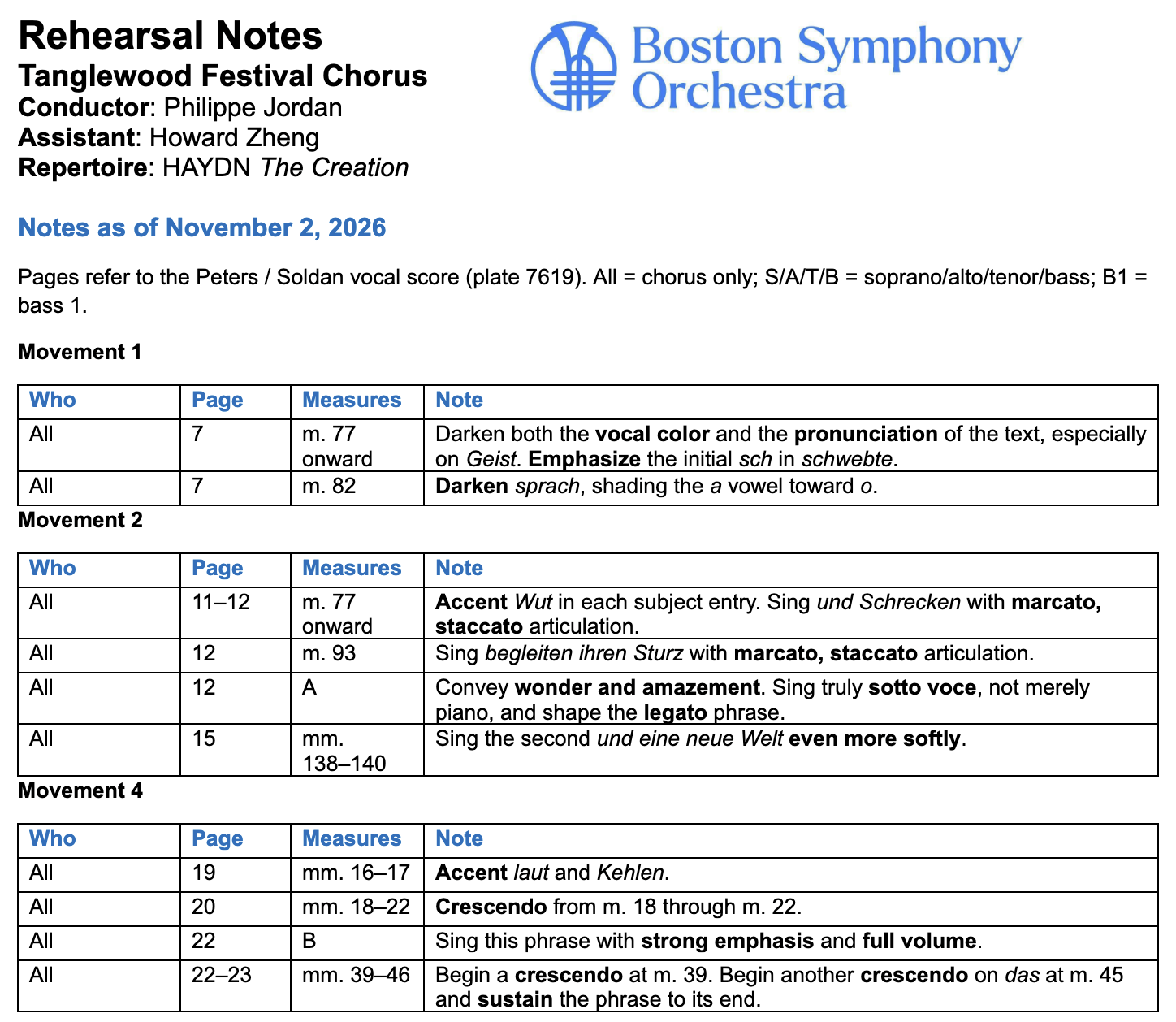
Throughout the process, JS treated us like professionals. Here are the notes – go read them, mark them, and come back prepared And we did. We also had Howard Zheng, our NEC Choral Conducting Fellow, running some of our warm-ups and taking extensive notes about what we needed to fix. That’s a real upgrade in how we prepare, and layer by layer, the piece started to take shape.
Bringing It All Together
If the preparation was baking the Baumkuchen, then the rehearsals with Maestro Philippe Jordan were the icing.
It’s easy to underestimate how much work this piece involves for the chorus, despite our only singing for not even a quarter of the movements. There’s so much orchestra, so many layers, and so many examples of back and forth between the soloists and the chorus. We had three full orchestra rehearsals scheduled to satisfy the conductor, more than we might normally have for a piece where the chorus sings relatively little.
Maestro Jordan came in with a very clear vision of what the piece should be, and he is just as clear in his signals. Many of his changes added to the drama (in a good way!) to make for a more interesting, more enjoyable interpretation: varying dynamic levels or phrasing in ways we hadn’t considered, or conveying emotions like breathless amazement, achievement, and pride. Other directions from him were simply reinforcing what JS had already given us: where S’s and R’s should land, how to approach certain passages. It was like viewing artwork from a different angle. He wasn’t just coaching the chorus, either. He asked for many things from the orchestra, such as a fiercer roar out of the lion (he asked the orchestra if they had ever been on a safari), and politely but relentlessly drilled them on his preferred entrance tempos, rubatos, and dynamic phrasing.
By far my favorite moment with Maestro Jordan came during the piano rehearsal. In some fugues, we basses had been holding back on our entrances. That’s not what he wanted; instead, he was exhorting us to come in fortissimo to establish the fugue’s theme. To demonstrate, he gave us a grand, sweeping gesture before our entrance and boomed out, “BASS!” It’s hard not to come barreling in when you see that upraised hand each time. Those spots are by far our most satisfying entrances now, and all he has to do is give us that same look.
All this makes Maestro Jordan, conducting from his fortepiano bench, a delight to sing for.
Why I Keep Saying Yes
I think I’d say yes to this piece any time it came up in the rotation. Part of that is a selfish practicality: this piece sits in a sweet spot for my voice, and by now I know it well. It’s a good sing for a bass. But the bigger reason is that, even after all these years and several performances and listens, The Creation still surprises me. The sunrise gets me every time. The lion’s roar and the worm’s crawl still make me grin. Singing it with a conductor who knows exactly what he wants, in a chorus that’s been prepped with this much care, reminds me of the joys of singing every time.
Here’s one funny story from rehearsal worth sharing. Maestro Jordan was coaching the tenor soloist to add a little more caution and foreboding to his final recitative. “Remember, you’re warning them – don’t eat the apple!” Someone on the risers to my right snorted and said, playfully, “Hello? Spoilers!” That cracked me up, because this is literally one of the oldest stories ever recorded, and the idea of somehow spoiling it is hilarious.
Upon reflection, I realize singing this “old story” is a big part of the appeal. Everyone in the hall already knows how this story ends, and people have been telling it for about as long as there have been stories to tell. Haydn’s version still lands like news. It’s a privilege to be one small part of the latest telling.
I hope the audience enjoys it as much as we do. And if you can’t decipher a word of German, don’t worry. Haydn has you covered.


