Suffering, oppression, and struggle

Russian Soviet Army Fur Military Cossack Ushanka Hat (Black, 60 (L))страданье, гнет, and борьба!  The Russian words for “suffering, oppression, and struggle” sum up the Russian gestalt, as my good friend the Crazy Russian Dad confirmed. (He also suggested the chorus buy and wear these Ushanka hats, but alas, I don’t think they meet the summer dress code.) That is the world we’re entering as our chorus finalizes its preparation to sing Shostakovich’s 2nd Symphony on Friday evening at Tanglewood.

Both our Russian diction coach (Olga Lisovksaya) and BSO conductor Andris Nelsons spoke to us about the Soviet legacy, since both grew up under its shadow. They recounted the brainwashing in schools insisting that Lenin was the country’s god and savior. The two implored us to get past the distasteful propaganda-heavy text and sing the music for what it was. But honestly, I didn’t think that was too hard. Every time we sing a piece we are acting, whether we’re pleading to be spared God’s wrath, gluttonously worshipping false gods, or sadly bidding farewell to our maimed star-crossed king.  Heck, for Holiday Pops, Christian chorus members sing joyful Hanukkah songs and Jewish chorus members sing reverently about the Nativity. Is this that different?

This symphony, however, is odd. The composition includes some “abstract music” with unusual layering effects. It was commissioned to celebrate the 10th anniversary of the October Revolution.  Shostakovich himself didn’t like the results, calling his 2nd and 3rd symphonies “completely unsatisfactory,” as he struggled setting the words to music.  The piece itself is rarely performed, unless a group (such as the BSO) decides to do a Shostakovich cycle. In fact, our choral scores were assembled just for us: the Cyrillic transliterated, the music photocopied, the pages spliced together from disparate parts. 

Having somehow dodged performing Stravinsky’s Les Noces and Prokofiev’s Alexander Nevsky, I finally had to learn how to pronounce Russian consonants and vowels that don’t exist in the English language (hint: it’s all in how you palatalize your tongue). I learned to be a good little Soviet who can sing the praises of Ленин and his revolution. 

If you’re listening this Friday night, here’s what to expect during these 20 minutes. The first section reportedly represents the chaos before order emerged, as clusters of instruments compete for attention. Then, there’s a meditative section described by Shostakovich as depicting a child killed on the streets. After that, more funky music including some beautiful solos.  And then the triumphant propaganda of the Oktober Revolution by Lenin, jarringly introduced by (I kid you not) a factory siren. In fact, Andris and the orchestra are still debating whether the siren should go full blast or stop at an F# for us to tune to.

While it won’t go down as my favorite Tanglewood performance, it’s been fun to lean into the role of devoted proletarians. At one point, Andris told us he didn’t think we were capturing the fervent adoration of the cult of Lenin when we shout his slogans before the finale, so he gave us this direction in his halting English: “I haven’t partaken of this, but… you know that new cannabis store that opened by the highway, with lines of cars around the block? Act like you’ve been there.” That’s right, baby… we’re high on Lenin this Friday!

What to expect in this Verdi Requiem

If you’re a Verdi Requiem fan and are attending the performance tonight (or listening to it on streaming), what should you expect from a performance led by Andris Nelsons?

It won’t be the wildly varied performance led by Maestro Montanero at Tanglewood six years ago. Nelsons is steady and efficient with his tempi, with predictable accelerandos and allargandos, taking space where it’s needed without luxuriating in the gaps.  He lets the Verdi’s composition bring the drama, rather than indulging in it himself.

It won’t be the deliciously dramatic affair six months before that, led by Maestro Gatti, with his choral tricks to help us achieve the effects he wanted. In the prep work, Nelsons presented very few wacky innovations or interpretative variations to make the piece his own. Sure, he wants to evoke terror and desperation in the Dies Irae, to evoke solemn prayer in the Agnus Dei, to evoke tragedy and loss in the Lacrymosa, and a sense of wonder for the Great Amen to close the second movement. That’s all good in my mind — these choices aren’t revolutionary, they’re true to the Verdi Requiem.

In other words, what you should expect is a well-executed, traditionally realized, solid performance of a piece for the ages.

A few places where fans of the Verdi Requiem may notice something special:

  • Vertical tuning. This is an area that our choral conductor James Burton always emphasizes, but I think it makes a noticeable difference in the a capella sections. It’s the mentality of “don’t just sing your note – listen to the other parts and tune to a B-flat minor chord,” or “as the root, you’re the fifth of this inverted chord, basses, so tune it higher.”
  • Stronger marcato on the Dies Irae moving parts.  Nelsons took extra time with the descending voices, and the orchestra parts that double them. He wanted to ensure that in the iconic Dies Irae chant, they swing through with stronger weight at the end of the phrase.
  • A deeper Libera me chant. The one innovation that Nelsons gave us is something I’ve never seen or heard before in six concert runs. He asked any basses who could go down the octave during the restless chanting in the opening of the final movement to do so… and not to restrict ourselves to pianissimo. It certainly gives it a weightier, darker sound.

As for the soloists, I’m a big fan of Ryan Speedo Green, and the gravitas and power he brings to the bass part. The four of them have strengths and weaknesses, and were still learning to be an ensemble together during their first run through on Friday. Hopefully they’ll earn more praise than criticism in the inevitable reviews.

Choir dynamics and hula hoops

Performing a piece like the Verdi Requiem is an exercise in extremes. To meet those extremes, the chorus must stay closely connected — a tough exercise that’s reminiscent of a frustrating hula hoop team building exercise.

Verdi, embracing the Italian stereotype, composes everything over-dramatically using severe contrasts. (You can almost see him wildly gesticulating with his hands about how loud or how soft he wants each section to be.) When first performed, critics said his Requiem was too much like one of his operas instead of a sacred piece. Look at any part of the score and you’ll probably see the chorus told to sing either pianissimo or fortissimo.  Sometimes even ppp or fff.  Sometimes even ppppp!  And even then there are internal gradations… it may say pp in one phrase, but then say düster (darker, more melancholy) or “a little less so” or some other direction in color or tone to show yet another contrast.  And don’t get me started on the subito piano moments when you suddenly drop from loud to an intense quiet.

Loud is relatively easy for a choir to do together. The tricky part is to not oversing and to listen to each other rather than “leading.”  The conductor then balances the orchestra volume (because when it’s orchestra vs. chorus, the orchestra can always win.)

But quiet… quiet is another matter entirely, especially given the heavy orchestral scoring which often features lots of brass.  It’s way too easy to sing, as some have jokingly called it, mezzofortissimo.  Yeah, you know this is supposed to be quiet, but hey, I can barely hear myself over others, so maybe a little louder… a little louder… until those dynamic contrasts are washed away by a middling volume.

It reminds me of the hula hoop team building exercise I mentioned. Now when I say “team building,” what I really mean is “team shattering,” because the first stage of the exercise usually devolves into everyone yelling at each other. Everyone stands in a circle and holds out pointer fingers, and a moderator balances a hula hoop on them. The goal is to lower the hoop as far as possible, without it ever losing contact with a teammate’s fingers. In practice, what happens is the hoop keeps getting higher and higher because you always feel like someone else (the singers next to you, the orchestra) is going higher than you, and you feel compelled to correct for it.

The only way to successfully get the hoop lower is to work together, to trust that others are doing what they’re asked to do, and to communicate and coordinate clearly.  What a coincidence – that’s how to maintain a pianissimo against the desire to produce a louder sound.

During our chorus’s initial piano rehearsal of the week, it felt like many of our pp‘s had become mp’s and that we weren’t getting enough contrast. But by the first orchestra rehearsal, we achieved the feat of being told we were too quiet for one passage. (The solution was not to sing louder; rather, Andris Nelsons held back the orchestra even further.) We have plenty of other places, however, where our mezzofortissimo is showing. That means more ensemble work needed before Saturday to get that hula hoop moving in the right direction.


The Half-Blood Prince’s Verdi Score

When you’ve sung the Verdi Requiem several times, including a few times with the same choral score, your score starts to look like it belongs to the Half-Blood Prince.

Harry Potter fans will recognize the reference. In the sixth book of the series, Harry accidentally ends up with a beaten-up Potions textbook from someone called “The Half-Blood Prince” that has all sorts of scribbles in the margins and strange recipe modifications. He soon learns that if he follows the annotations, he outperforms classmates who are going strictly by the book.

My score has notes from past me’s scattered throughout: circled notes in tricky passages, eyeglasses warning me when to watch for a new tempo, pronunciation reminders, emotional tones to convey, explicit phrasing indicators, dynamic corrections, and other modifications inherited from previous conductors who had reached some areas of consensus for how the piece should be performed.

This is not without its disadvantages. The helpful quarter-rest out given to you three choruses ago to let you tackle the next fugue strongly may not be what the current conductor wants. So you have to be judicious in deciding what scribbles to keep and what notes to erase.

The danger of all this – as it was to Harry Potter in the books – is trusting the notes too much, and falling prey to the sense of complacency that comes from having sung a piece many times. Yes, I could walk in without rehearsals and sing One must always be hungry for more. One must always improve.

Just as a good actor knows his lines but a great actor knows everyone’s lines… or how a good team leader understands his role, but a great team leader understands how to bring out the best of each teammate’s abilities…  a good chorister knows his part down cold, but a great chorister knows not only his notes but also how he relates to the other parts.

Our conductor James continues to ask us to focus on vertical alignment and listening to each other.  That means knowing that third of the chord or the fifth of an inverted chord needs to be a little sharper.  Or that the women and men in the Lacyrmosa movement dance around each other as countermelodies.  Or that our opening theme should be strong in each fugue entrance but then fade into the tapestry afterwards. It’s those sorts of advances that take us beyond what’s on autopilot and lets us truly live each performance as if it were our first.

That’s what I’m striving for from this performance.

Thoughts after a successful reaudition

It’s been over a month since I got the gratifying news that my 21 years of service with the Tanglewood Festival Chorus would be extended at least another two years. A month is enough distance from the excitement, relief, and sorrow to reflect on what this means.

I don’t take this for granted. Though many more cuts to the membership happened in the first year, cuts did happen, and it’s hard not to see those members leave without pondering how I would feel and what I would have done. I told myself I would have finished out the summer and gone right back and re-auditioned next year, but those bold words are easier from this vantage point. I know it must hurt.

Those auditioning could receive renewals of up to three years, but I think my two years was quite fair given how it went. I know I’m pretty good at providing what our conductor James Burton is looking for. But I also know that I have a lot to work on, whether it be better breath control, tuning my ear to other parts, or finding that resonating ‘ping’ that sometimes eludes me. I’m improving how quickly I can achieve that alignment and get it right. I need to keep working until I can’t get it wrong.

I can also sense a confidence spreading across the chorus – a confidence that we belong. Until passing the re-audition, in the back of your head everyone wonders “does James want what I’m offering, or is my time here limited?” Once you’re through at least once, you’ve reaffirmed that you belong. At this point, everyone in the chorus has either passed a re-audition or was given three years right after the sing-in… so “we all belong.” It reminds me of when I worked for a company that started administering an aptitude test to all candidates before they were hired; those who failed didn’t even get an interview. They even asked current employees to take it as well. Though many proclaimed the process obnoxious, after a year of this, you knew that virtually everyone in the company had objectively demonstrated competence. It raised your trust. You knew you wouldn’t have to cover for someone, or be dragged down because someone didn’t have the ability to succeed.

That said, I’m reminded of stories about how newly elected members of the House of Representatives start thinking about the next election right away. I’ve got two years to build on my strengths and repair my weaknesses, so that I can go into the 2021 re-audition with even more confidence. Onward to this summer’s performances of the Verdi Requiem, another go at Ravel’s Daphnis et Chloe, and a whole lot of Russian for Shostakovich’s 2nd Symphony!

Good, not great – and now, the wait

All in all, I had a delightful (re)audition experience, even if my final performance was not as great as I wanted it to be.

The whole day, I felt like I had swallowed a potion of felix felicis — I was in an inexplicably good mood.  But as I traveled over to Symphony Hall, I could feel my heart rate climbing and the back of my neck sweating.  Thankfully, I had a good half hour plus to warm up and try to physically calm myself down.

What I learned… is it’s very different to sing under those physical conditions!  I could feel some elements of my technique slipping, and I missed a few full breaths that left me  scrambling for air at the end of two long phrases.  I acquitted myself on my solo selection despite those issues, and I did fine on the slower-than-expected-tempo prepared piece (except for a very unfortunate part where I mangled a word, and that threw me for such a loop that I got ahead by a beat – still not sure how I did either of those, but I reset and soldiered through to the end.)  I was pleased with my sight reading: even if my breathing was terrible and I had to stop once in each piece, I thought I got intervals and dynamics and rhythm pretty darn well for reading.  And the ear training?  A lot harder than what I had been practicing, frankly, but I think my solid music theory and my ear got me through it.  It was not my best possible performance — always more you could have done, right? — yet it was one I’m proud of.  I know my voice has developed significantly over the past few years, and despite the flaws I believe I showed what I came to show.

I may have fought off physical symptoms, but mentally I felt completely at ease.  That was in part because James Burton was more of a host than an adjudicator; he came bearing welcoming smiles and knowing nods, full of the same enthusiasm and energy he brings to rehearsals.  (Maybe because I was #2 on day 2; I hope he can sustain his gusto all the way to #8 on the final day of reauditions!)  They even arranged for the accompanist to come over to the practice rooms to run through my solo piece and get tempo and markings, rather than winging it within the chorus room — truly a luxury for an audition!  It was more than fair.  Maybe it was lingering effects of that luck potion, but it felt like everyone on staff wanted all of us to succeed.

I’m still bemused that, despite my confidence, the body still betrayed the mind.  Perhaps the next time I do an audition, I’ll heed a suggestion from a conversation with the assistant chorus manager: she’s heard of violinists who run up and down stairs before practicing for an audition, to simulate the shaky hands and pounding chest that often comes with the territory.

In the meantime, it’s a few weeks’ wait until the results are announced.  I’m thinking positive and expecting a three year renewal.  I would understand a one year renewal.  If I’m not renewed, then I think I’d still sing this summer and then plan to audition again.  I have too much left to sing.

Tomorrow is my re-audition day

Tomorrow, around 6:15, I’ll walk into the chorus room at Symphony Hall. I’ll smile and turn to the panel of evaluators, and confidently answer their question, “What will you be singing for us?” with “Roger Quilter’s Dream Valley, from Three Songs by William Blake,” and give each of them a copy. I’ll stroll over to the accompanist and hand over another copy, and quietly sing the first two bars to set the tempo. Then I’ll take my place, music-less, and smile as the opening notes remind me of the key. I’ll wiggle my shoulders a little to get comfortable as I tilt my head downwards, opening the back of my throat and keeping my larynx correctly positioned. I’ll remember to breathe from my upper lungs not just my diaphragms for full breaths. And I’ll sing with a knowing smile, while hitting the breaths and phrase shapes and dynamics that I’ve been practicing over the last 4-6 weeks. I’ll put to use the extra coaching I received from a master class and private lesson, and be in the moment.

Once completed, I’ll turn for my music folder and pick up the Finzi excerpt we were asked to prepare. I’ll come in perfectly on time and sing the three minutes of high and low music across several key, tempo, and color changes, with great cutoffs. I’ll finish on my final low note with another smile.

Then I’ll receive one to two sight singing pieces to work through. They’ll be unfamiliar pieces, but straightforward enough in rhythm with some tricky intervals and tonality changes. I won’t get them all right and that’s to be expected while reading a piece, but I’ll do well enough to be pleased.

Finally, I’ll tackle the ear training session, naming intervals, singing middle notes of major and minor chords, picking out 4ths and 6ths from established tonalities. I’ll treat it mentally as a game, just like the app I was using to quiz myself over the last few months.

I write all this down because this is my affirmation to myself. This is the visualization I’ve run through in my head each night and each morning. I can see the room; I can hear myself singing; I can feel the sense of triumph as I finish my solo selection. It’s always been important for me to set goals and to visualize success, and I walk into this re-audition feeling confident and secure. A part of me fears the Dunning-Kruger effect, where less competent people think they’re better than they actually are. But I know how much I don’t know, and how much better people who have studied all their lives are than me. I don’t aspire to be the best. I aspire to be better than I was, and good enough to sing another three years with the Tanglewood Festival Chorus. We will see what tomorrow brings.

Sadness in choral music

Dvořák’s Stabat Mater is the saddest choral music I’ve ever sung.

From the opening 20 minute movement, throughout most of the first half, it functions as a musical personification of a grieving mother before her dying son. And even the later movements, excluding the apotheosis and redemption of the final movement, all have an undercurrent of yearning and loss, representing the prayers of a supplicant asking to share the burden of her grief.

Don’t get me wrong – I’ve sung many sad moments in lots of musical pieces.  The lament for Oedipus at the end of Oedipus Rex is sad, but in a less personal, Greek chorus sort of one-minute farewell-to-thee.  Every Lacrymosa of every Requiem Mass has its own brand of sadness, though they’re often tinged with fear, too.  And other Stabat Mater settings, such as Verdi’s, also try to capture sadness.

I’d argue, though, that most sad choral music is melodramatically, stereotypically sad.  It screams, “Look at us, we are SAD!”  Minor keys, wailing violin accompaniment, soaring melodies that decrescendo as the line lingers on the seventh of the scale before falling to a hushed cadence.

The Dvořák sadness is personal, not ostentatious.  It’s a crushing, persistent grief.  It’s a mourning that sees no future without more mourning. Its consolation is only by crying it out through nine movements before it approaches a sense of hope and redemption at the end. As I wrote about in my previous post, Dvořák had suffered through the separate deaths of his three children, two within a month of each other.  I’ve been fortunate in my life not to have lost any immediate family so far, but this is how I expect that to feel when it happens.

Next time you see me (or anyone singing the piece this week) in person, ask us to sing the opening lament by the soprano section.  It will break your heart.

To accomplish this effect requires a lot of precision, but without looking precise — the musicality still has to shine through the proper cutoffs and rhythms.  Our choral director James Burton has been reminding us of the important of shaping every phrase,  not just when the hairpin dynamics are explicitly indicated.  We’ve played with the balance of voices, as different parts take control of the melody or serve as the tonal foundation that others play around.  (That’s personally fun in the third movement, where the basses take command of the melody… though Andris Nelson’s deliberate tempo will be challenging for us!)  We’ve had mixed success capturing the dramatic changes in dynamics.  With all the things going on, sometimes it’s hard to remember that pp doesn’t mean “mezzoforte,” and that not all fortes are equal — we have to hold something back for those dramatic buildups or there will be no climax left for the audience at their peaks.

After an admittedly shaky initial piano rehearsal earlier in the week, though, we redeemed ourselves in the first full orchestra rehearsal last night with some magical moments.  We’re looking forward to bringing this emotional piece to life this weekend.


Dvořák’s Major Surprises

I’m thrilled to be on the Tanglewood Festival Chorus roster for the performance of Antonin Dvořák’s  Stabat Mater at the end of February.  We are deep into the rehearsal cycle, exploring the choral blends, hairpin dynamics, and unusual tonalities that mark Dvořák choral music.

There’s one particular musical bookending in the Stabat Mater that’s so full of emotional payoffs it gives me goose bumps every time I hear it.  Here’s some background and music theory to explain why:

Dvořák’s first movement sets the opening stanza of the Stabat mater text:

Stabat mater dolorosa
Juxta crucem lacrymosa
Dum pendebat Filius

It translates to The sorrowful mother stood, weeping by the cross where her Son was hanging.  Once you learn that Dvořák wrote this piece after the deaths of his three children — Josefa two days after her birth, then later his one-year-old daughter Ruzena from phosphorous poisoning, and within a month three-year-old Otakar to smallpox — you understand just how much emotional anguish Dvořák poured into composing this piece about a parent watching a dying child.

Dvořák sets the first movement in b minor, but makes heavy use of diminished chords.  Because diminished chords are four symmetrically spaced minor triads, they don’t really belong to any one key signature.  They are “scary” music chords – not discordant, per se, but implying anger, passion, fear, or danger.  They also muddy what key you’re in, because they can resolve in a lot of different directions.  (By no means did Dvořák discover the effectiveness of these chords; even baroque composers used them.  My favorite is the crowd screaming to release Barrabas instead of Jesus in the St. Matthew Passion.)

See and listen to how he builds up the drama, about 9 minutes into the first movement. The chorus crescendo peaks as the timpani join the orchestra for a giant diminished fortissimo chord, echoed two measures later.

Stabat Mater diminished chords

This is repeated again a minute later, before the soloists join in… and again about 140 measures later at the recapitulation right before the end of the movement… and again after that!  So he’s pretty much established that giant build up leads to big scary diminished chords, suitable for a despondent Mary weeping at the feet of Jesus.

Fast forward to the tenth and final movement of the piece.  The text has moved from lamenting Mary’s fate to praying that she’ll defend us on our days of judgment:

Quando corpus morietur
Fac ut animae donetur
Paradisi gloria.

The final movement takes this translation — When my body shall die, grant my soul the glory of paradise — and puts it in doubt.  “Please, please, PLEASE let me into heaven when I die!” And then… uh oh!  The same theme that we heard at the beginning plays again.  We had this beaten into us already: this is the sad, scary music!  We’re not gonna make it!

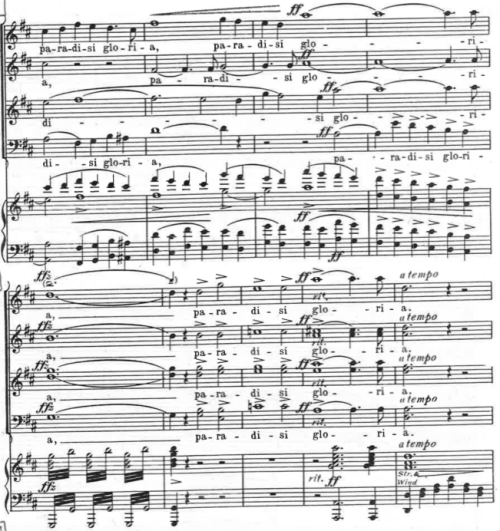
Until… instead of dramatic, unresolved tension… it’s a psyche out!  Paradisi gloria bursts forth in a G major chord instead of the diminished chord, taking us back to D major.

Dvorak paradisi gloria

Love.  It.  This is the introduction to the end of the piece, where suddenly this lugubrious lament turns into a celebration of making it into heaven, including a thrilling a capella confirmation of yes, we made it to paradise that echoes the major twist above.

Dvořák must have liked this trick, because he did it again about 13 years later in the Dies Irae his Requiem mass.  First listen to his build up on cuncta stricte discussurus as the chorus sings about the Final Judgment.  Then listen to the recapitulation when, instead of going back to the day of wrath, the piece charges forward into a major key, bells ringing, to talk about the majestic trumpet sounding to call all the dead forth to God’s throne.

These are the music theory equivalents of whodunit plot twists.  Setting you up with foreshadowing, then zig instead of zagging with an unexpected progression.  They hit you over the head and say, “Pay attention!  Something momentous is happening here!” in a way that dynamics and rhythm alone can’t achieve.

The Return of Pizzetti

Last summer, the Tanglewood Festival Chorus sang an absolutely gorgeous, sumptuous a capella Requiem from Ildebrando Pizzetti.  It may be one of my all-time favorite concerts that I’ve ever performed in.

This January, we get to do it again.

The unusual encore presentation is during one of the Boston Symphony Orchestra’s four “Casual Friday” concerts this season at Symphony Hall: lower priced tickets, casual dress, a free pre-concert reception, and a post-concert affair with live music, snacks, and a cash bar.  In this case, there’s a shorter program (28 minutes of Mozart’s Piano Concerto No. 24, 35 minutes of Vaughan Williams Symphony No 5), and then, according to the BSO’s site:

In a special one-night-only performance, following Friday’s concert, the Tanglewood Festival Chorus, led by conductor James Burton, will perform Pizzetti’s Requiem, for a cappella mixed chorus, on the Symphony Hall stage following a short break.

From a programming perspective, this is a first.  While I’ve seen the TFC prepare and sing complete programs before, it’s always been as a prelude concert out at Tanglewood, or an occasional program in Jordan Hall — never unaccompanied as part of a BSO concert.  It’s a testament not only to the closer collaboration between our conductor James Burton and the BSO team but also to how mesmerizing the performance was last summer out in the Berkshires.

I wrote previously about preparing for the performance last July, though I didn’t complete the story. One day before the concert, we were still not ready.  James Burton was visibly upset as we continued to miss cues, to botch entrances, to look down at our scores instead of up for his direction, and to lose the rhythmic intensity needed to propel the piece forward.  It was a harrowing moment, that last full rehearsal.  But we came back after the break and pulled together a showing that demonstrated that we were committed to getting it right.  In the 24 hours between that last rehearsal and the performance, it felt like every single singer went back to the hotel rooms and hunkered down with the score anew, re-running it in our minds, re-studying each pencil mark he had given us, re-imprinting it in our minds so that we’d really be ready.  By the time we hit our pre-concert warmup, it was clear that as a group we knew the piece cold and were ready for him.  He spot-tested a few transitions and we were responsive and deeply attuned to his intentions.  The performance that followed was breathtaking.  (We have private recordings that we can’t distribute; those of you who know me, find me some time and ask to hear it, and I’ll try not to point out all the flaws.  Even a breathtaking performance is not perfect.)

Now we get to do it again, though with some new additions who weren’t on the previous roster who are playing catch up.  Some ad hoc groups have already formed to go over the piece together before the two official rehearsals, because there’s only so much study you can do on your own.  The lines of each part, on their own, aren’t particularly complex.  It’s the way they interact with each other that’s tricky: different parts taking over the melody, dovetailing rhythms, harmonic progressions that require vertical tuning, and subtle dynamic changes that play off of other parts.  Mastering this required not only learning your part but also how you fit into the whole, with listening more important than  singing.  The result is a many-layered polyphony that has shape and meaning and drive.  Many choristers are already looking forward to a chance to repeat what we feared might be a once-in-a-lifetime experience.

If this outing is a successful one, then we may see summer prelude programs make more regular winter appearances at Symphony Hall.